Colonel Kane (Stacy Keach) is an army psychiatrist who arrives at a top secret, experimental mental asylum in an old castle that was imported to the United States brick by brick where military men who have suffered a mental collapse are treated with unusual methods, though not everyone believes they genuinely have an illness. Kane and the resident doctor Fell (Ed Flanders) decide to give these men what they want and comply with their every demand, leading to chaos. One patient, Cutshaw (Scott Wilson), is an astronaut who had a breakdown just as his space capsule was going to be launched to the Moon. He provides Kane with his most formidable problem: prove that God exists...
The Ninth Configuration is a fascinating, frustrating, theological drama written, produced and directed by William Peter Blatty, who also appears as one of the patients (the one who thinks he's a doctor). Originally it had trouble getting released, probably because nobody knew what to make of it. Is it a comedy? A fantasy? A thriller? It has even been described as a horror, a follow-up to Blatty's most famous work, The Exorcist. One thing is clear, though, Blatty's religious preoccupations run through this film just as they do in that celebrated shocker, but here he is not concerned with the existence of the Devil, but with the existence of God, and the reason there is any goodness in the world at all.
At first we are introduced to the characters in a confusing scene where dialogue overlaps, creating the sense of random thoughts running through the head of a schizophrenic, some of them very funny, but a lot off-kilter and bewildering. The inmates are running this asylum even before Kane gives them a free hand, and there are constant interruptions where the actors can indulge themselves in acting crazy, sometimes with improvisations. One is trying to stage Shakespeare with dogs, one thinks he is Superman, another believes he is being held captive on the planet Venus, and yet another is determined to walk through walls so he can teach atoms a lesson.
In time the plot emerges. Kane is not all he seems; in a superb, unsettlingly restrained performance by Keach, he speaks calmly and reasonably while it is clear that he is wrestling with inner demons. He confides in Dr Fell about his brother, Killer Kane, who went on a rampage during the Vietnam War, and, inspired by Cutshaw's machinations, begins to take the view that the inmates are indeed acting insanely to avoid the consequences of their actions. There is a big twist near the end, which you might be able to guess if you're paying attention, but with everyone acting eccentrically, it's difficult to tell who's mad and who's sane, a plot point that may have been verging on cliché as seen in efforts like King of Hearts, but Blatty really went to town on the premise.
Eventually, the film appears to reach the conclusion that people reject sanity to avoid what really scares them: in Cutshaw's case, it's the terror that he may be alone in the Universe, that there is no God, which made the possibility he might die in space too horrendous for his mind to cope with. It becomes Colonel Kane's mission to prove that, just as there is senseless evil in the world, the Catholic idea of Original Sin in action, there is also altruistic good. This culminates in an incredible scene of violence, where Kane has to save Cutshaw from a gang of Hell's Angels who are victimising him in a local bar in a sequence that makes all the meandering chat that has gone before both worthwhile and appreciating a point, the method in his madness if you will.
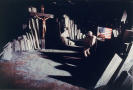
Ironically Kane has to give in to the side of his personality he can't admit to for him to receive redemption; but Blatty's concept is flawed: for a truly selfless act, surely Kane would gain nothing for his act of good? Here he finally get the peace of mind he so desperately craves, and the gratitude of those he has saved when he takes his religious allegory too far, providing the "shock treatment" that puts the patients' shenanigans into the proper perspective. The Ninth Configuration is thought provoking, but dashes your hopes for solutions by asking unanswerable questions, some posted by the terrific dream sequences, which featured an astronaut finding the crucified Christ on the moon, and Vietnam War flashbacks. Essentially, it was the refashioning of the lead up to the Crucifixion where the messiah figure fought back against the sins he was intended to die for, for our sake. Music by Barry DeVorzon. Try and see the version just under two hours long, it's Blatty's preferred cut (there are a few versions about).
Aka: Twinkle, Twinkle, Killer Kane
[The Second Sight Blu-ray could not look or sound better, and it has a host of special features, some like the audio commentary with Blatty and Mark Kermode carried over from the previous American DVD, though there are also interviews with cast and crew that are new. For fans and newcomers alike, this is the best way to see the film.]