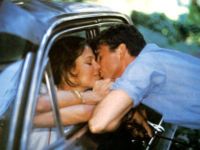
Indonesia in 1965, and there is trouble brewing with Suharto planning a military coup to oust the ruler Sukarno, not that anyone is prepared for this as the general reaction among the Westerners there, despised by many locals for their perceived imperialism, is one of ignorance or at least bemusement. But for Chinese-Australian journalist Billy Kwan (Linda Hunt), he thinks he can find someone to feed the world at large the type of exposés he feels can wake them up to the dangerous situation in Jakarta and beyond. That someone has just arrived from Sydney: newspaper reporter Guy Hamilton (Mel Gibson).
Most of the publicity from director Peter Weir's The Year of Living Dangerously centred around one of its cast members, as Hunt was a woman playing a dwarfish man here, and securing a Best Supporting Actress Oscar for her trouble. Yet there were controversial problems involved with the shoot which saw not only Weir battling the writer of the original novel, C.J. Koch who didn't agree with his artistic decisions, but also on a larger scale the death threats the cast and crew received due to Islamic fundamentalists believing them to be making a film critical of their religion instead of being critical of blinkered Westerners and totalitarian regimes.
Considering this was originally to be filmed in Indonesia one can only wonder at what troubles they could have gotten into if production hadn't switched to the Philippines, though even there they were still the centre of controversy and after recording as much footage as they could they decamped to Australia where the designers did their best to recreate the Jakarta of 1965 there at some hardship. Though not as much hardship as getting blown up by aggrieved fundamentalists, presumably; that said, it did ironically underline the gap between the two societies that neither truly trusted the other, granting that to be fair the Australians wouldn't have threatened Indonesian filmmakers in their nation with death.
Well, let's hope not, anyway, yet trying to get to the bottom of all these political and social grudges was relevant to the matter in hand, and Guy is rather naively embroiled with what to foreign eyes are local skirmishes, and maybe in the eyes of the filmmakers, too. That was an issue, that we saw a country descending into chaos, a lot of it murderous, and we were meant to be relieved if the white characters got away to leave the Asians to it, an unspoken prejudice which was never quite obliterated by the good intentions relayed by the Billy character. That Hunt to some extent saved this from more criticism was the main reason to watch, as Gibson and Sigourney Weaver, as his British attaché love interest, belonged to a far more ordinary yarn.
Billy is the closest thing we had in the film to allowing us to understand the terrible poverty and political tactics which whipped up both the citizens and the authorities into the frenzy they keep verging upon. It's worth remembering Suharto was still in power when this was made, and would be for some years afterwards, so the concerns the script raised were very much to the fore in global news when this was made as after all, Indonesia was not the only Third World dictatorship around, rendering it a pity that in the end, Weir managed to create a convincing atmosphere of peril and paranoia, but fumbled the clarity that would have us understanding what was actually going on. You could observe this accurately reflected the mindset of the Guy character, and we were seeing this through the filter of his experience, but that was denying the importance of Billy, and how he was meant to be clearing things up for us. So it looked very authentic, felt the same, but educationally this was a dead loss. Music by Maurice Jarre.
Australian writer and director with a touch of the mystical about his work, usually fish out of water dramas. After various short films, he made The Cars That Ate Paris, a darkly funny horror which nearly ended his career when it failed financially. But he bounced back with Picnic at Hanging Rock, an international hit which led to apocalyptic fantasy The Last Wave, war tragedy Gallipoli and political thriller The Year of Living Dangerously, whereupon he moved to Hollywood to direct Amish thriller Witness, survival tale The Mosquito Coast, Dead Poets Society (possibly his worst film), comedy Green Card, spiritual air crash drama Fearless, science fiction satire The Truman Show, historical adventure Master and Commander: The Far Side of the World and WW2 era trek movie The Way Back.