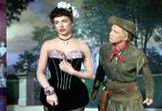
Calamity Jane (Doris Day) is heading back into the town of Deadwood after defending the stagecoach from Indian attack, and she is in a good mood. When they arrive, she helps unload the packages as she greets the townsfolk, and then it's straight into The Golden Garter where she asks for her usual tipple, sarsparilla. But as she tells her story of the day, exaggerating mightily, she is put out when the men are more interested in opening their cigarette packets and seeing what cards they have. Some of them are delighted to find pictures of singer Adelaid Adams in there - now why can't Deadwood attract that kind of entertainment?
Offered to her after losing Annie Get Your Gun and reputedly Doris Day's favourite of her roles, Calamity Jane has been rather undervalued in recent decades for playing fast and loose with history (don't expect an accurate lesson here) and its supposedly reactionary attitude towards women, where it tells the ladies in no uncertain terms that the best place for them is at a man's side and staying at home. All this is somewhat unfair, and belies its other reputation as a film that became a favourite among lesbians for having its leading lady proving she was as good as any male, and being an avowed nonconformist to boot.
This is a far richer film than it's often given credit for, partly down to a superb run of songs from Sammy Fain and Paul Francis Webster that are performed with matching skill. In fact, the soundtrack recordings were enormous hits in their day, and arguably more popular than the film they hailed from, with the ballad Secret Love spending about ten weeks at the top of the British charts alone. It's not all lovey dovey, as the score also includes Day's infectious exuberance shining through in such belters as "The Deadwood Stage" and "Just Blew in from the Windy City"; with irresistable tunes like that you can hear where the appeal to fifties audiences stemmed from.
Another reason why this is worth revisiting is the theme of staying true to yourself and your emotions. As counterpart to Jane's crossdressing, the actor (Dick Wesson) who is meant to put on a show for the men of Deadwood has been billed as a woman, and is forced to go on done up in a gown and wig, fooling everyone but Jane, until the wig comes off anyway. To make up for this, she promises to get Adelaid to the town as compensation, but who she actually gets is, unbeknownst to her, the maid Katie Brown (Allyn Ann McLerie), who has been left behind when her boss goes on a tour of Europe. So here the pretending to be someone else part of the film is underlined when Katie returns so she can take to the stage under her boss's name.
Even co-star Howard Keel, playing Wild Bill Hickock, dresses up as a member of the opposite sex, but he has lost a bet when he said Jane could not make good on her vow. Unfortunately, it turns out he was right and Katie is found out, but manages to win over the crowd when she finds her own voice - there's a message here, as you'll see. It is the singer from Chicago who turns Jane's life around, showing her how she can allow a "woman's touch" into her life while still remaining essentially the same person, so the film ends with an amicable compromise rather than Jane being trodden underfoot by the chauvinist conventions and chained to the sink. Of course it is Bill who is her secret love, and he sees that he can come to friendly terms with Jane as Katie and Jane's other love, the man who didn't really deserve her, do. Those who criticise Calamity Jane for its outdated sexual politics tend to disregard the fact that she rides on horseback at high speeds to save the day and carries a gun in her wedding dress (!): it's really about the rewards of striking a perfect balance. And Day's rendering of Secret Love will never be bettered.