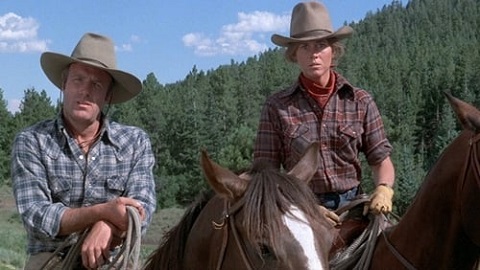
The year is 1945 and America is expecting the world war to be at an end soon, though sadly the death toll continues to rise, including the son of rancher J.W. Ewing (Jason Robards Jr) who has been buried on his father's land. Attending the funeral is Ewing's younger cousin Ella (Jane Fonda), who makes a point of not speaking a word to him thanks to bad blood between them, but when she returns home to the house on her own land, he is there to tell her he means to take her ranch so he can have all the region to himself and make huge profits from it. Ella can profit too, if she agrees to his terms. But she is stubborn, and then there's the arrival of Buck Althearn (James Caan)...
Buck, aka Frank, arrives in dramatic fashion having been shot by Ewing's men who are growing ever more ruthless in their domination of the area; his partner, played by Mark Harmon, is murdered by them, but Buck survives and recuperates in Ella's barn thanks to her helping him out with some of his land some time ago. Their relationship remains a wary one, but then Ella is understandably wary of all men except Dodger (stuntman turned actor Richard Farnsworth), who helps out on her ranch. This trio come to a mutual respect, more through circumstances than anything else, in a Western that was a distinct change of pace for its director, Alan J. Pakula, fresh off All the President's Men.
Comes a Horseman did not do anything like as well as that Watergate multi-awards winner, and as such has been given short shrift, both at the time when it was not as much of a success as the talents involved might have usually commanded, and since, where it was considered the ultimate example of pretentious Hollywood types trying to roll up their sleeves and get their hands dirty amidst the country folk. Certainly the title didn't help, reminding you the nineteen-seventies was a time when a movie about a killer mutant bear could be named Prophecy rather than Night of the Blood Monster or whatever. Yet some looked past that, and its self-serious tone which is both asset and drawback.
It may have been accurate to observe Pakula, who was also recently completing conspiracy cult classic The Parallax View, was beginning to see his artistic decline, particularly among those who had previously held him up as a talent to judge alongside the movie brats of the decade, but Comes a Horseman was not such a massive departure when you examined it. After all, it was still a tale of a smalltime group of people fighting back against a more dangerous authority, and interestingly J.W. is falling victim to that himself as the oil men make their move to buy up his land, and that of Ella's. One of the most menacing aspects are those prospecting explosions that keep threatening her property, making plain she is a very small fish in a very large pond, and they could buy and sell her as easily as destroy her.
Caan, always more comfortable in an urban milieu you would think, did have Westerns under his belt, and fitted in better than you would expect, while Fonda predictably threw herself into her role with as much dedication as she could muster, learning cattle roping and horse riding among other tricks, all of which she succeeded in creating a fairly convincing rancher. Her big scene was not so much the action, however, more the sequence where she admits why she has such hatred for J.W., and it's not solely couched in his intimidation, which added a more modern twist to the proceedings as you would expect from a revisionist Western of this period. Comes a Horseman was highly identifiable as from that stable, with Gordon Willis's murky photography, the naturalistic dialogue, and of course that need to present the film as an end of an era elegy to the genre that was going to struggle to find an audience as action movies replaced it in the public's affections. But of course, they're still making Westerns, not as many, yet the seventies did not see them off completely. Music by Michael Small.
[The BFI have released this on Blu-ray with the following features:
Newly commissioned feature-length audio commentary by novelist and scriptwriter Scott Harrison
The Guardian Interview: Alan J. Pakula (1986, 95 mins, audio): the director in conversation with Quentin Falk, recorded at the National Film Theatre in 1986
Jane Fonda in Conversation (2018, 71 mins): interviewed by Samira Ahmed at BFI Southbank in October 2018
Original theatrical trailer
Image gallery
Hereford Pedigree Cattle (1937, Mary Field, 10 mins): a subtly charming portrait of agricultural life in the west of England, featuring some fine pedigree cattle
The Grassy Shires (1944, Ralph Keene, 15 mins): a Ministry of Information film showing how cattle and dairy farms of the Midlands adapt to meet the demands of war
**FIRST PRESSING ONLY** fully illustrated booklet with new writing on the film and full film credits.]
As the eighties dawned, Pakula had a hit with Holocaust drama Sophie's Choice, but seemed to lose his touch thereafter with middling efforts such as the odd drama Dream Lover, expensive flop Orphans, hit thriller Presumed Innocent, failure Consenting Adults, Julia Roberts vehicle The Pelican Brief and Harrison Ford-Brad Pitt team up The Devil's Own. He was once married to actress Hope Lange and died in a road accident.