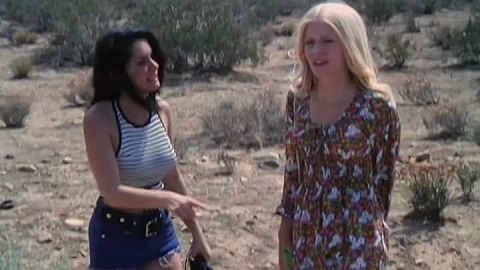
Maggie (Misty Rowe) is a teen who has recently been knocked up by her boyfriend, who on hearing of her predicament rapidly loses interest in her. For that reason she decides her only option is to escape to California, so early one morning she gathers a few possessions (but leaves her bra) and sneaks out barefoot to hitchhike to Los Angeles where she hopes to build a new life with the hippies there. She finds herself regularly picked up, but on the way she meets another hitcher, Diana (Linda Avery), who initially hostile, strikes up a conversation then robs Maggie of her cash, taking off in the next camper van that happens along. Now the hapless teen must make the best of a very bad lot...
The Hitchhikers was one of the first films from husband and wife team Ferd Sebastian and Beverly Sebastian, who ploughed the exploitation furrow for decades after; their best-known collaboration would be the Claudia Jennings vehicle Gator Bait, another movie that like this one could be termed hixploitation. But despite starring Misty Rowe, who would spend the next few years appearing on the hicksiest of all hick television shows Hee-Haw, this had other matters on its mind, or rather one matter in particular, which was a sensational news story that had coloured the hippy movement from 1969 onwards: the murders committed by the Charles Manson Family and their fall out.
Before that occurred, there were biker movies to cast a cult movement as the villains, but afterwards it appeared as if every counterculture exponent was either some draft-dodging waster or an actively dangerous exponent of trying to overcome polite society with violence. This was the sort that Maggie falls in with, but only after various sketchy adventures which saw her raped by one of her rides after she tries to escape from his clutches (he bought her a hamburger and apparently this means he can do whatever he wants to her), escapes a supermarket manager after helping herself to the produce without paying (she's lost her money, remember), and is taken to a ghost town.
This place is run (owned?) by Benson, no, not Robert Guillaume, but Nick Klar playing our would-be Manson who has his personal coterie of hippy girls who he has trained to pose as hitchers, then rob the good Samaritans. The fact that Maggie ran away because she was pregnant is dispatched with when she meets Diana again (she's a member of Benson's gang and has laid claim to him in her mind), and the raven-haired minx proceeds to thump Maggie in the gut a few times, triggering potentially deadly miscarriage that a doctor brought in from the local hospital sees to in an impromptu operation. All the way through hygiene seems to be the last thing on anyone's thoughts, which makes it all the more remarkable that our dizzy heroine emerges from this ordeal unscathed, and indeed feeling better than ever.
Initially, you may think that with a woman co-directing and producing, and a female writer on board as well, you may be getting a sympathetic view of how the hippy chicks were exploited by the men in their lives, and there was an element of that in Maggie's tale. However, once she was ensconced in Benson's lair, she takes to the criminal element like a duck to water (and yes, that does include a skinny dipping sequence), and a cheerily amoral mood took over, less because the Sebastians were amoral themselves and were promoting an illegal lifestyle, and more because they were throwing this stuff together as a collection of exploitation bits and pieces, apparently on the premise that if it was not allowed on television, then in it went. Some recall Rowe - the closest thing this had to a star - from her misbegotten turn as Marilyn Monroe in the same decade's Goodbye Norma Jean, and she was not much better here, not that she was offered many chances, buffeted around by the whims of other characters. Part dreadful warning to the squares, part invitation to the hippies, this was of its time, shall we say. Music, with explanatory country rock songs, by Danny Cohen.