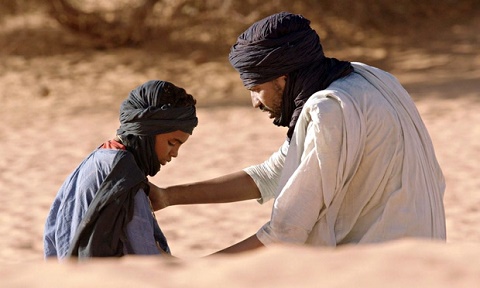
In Mali there is a civil war that sees the population landed under the thumb of oppressive fundamentalist Islamists, where their rules for living by seem arbitrary at first, but are enforced with disturbing emphasis, even to the point of murder. They claim to be working for the word of God, yet in a region near Timbuktu one of the actual religious leaders doesn’t recognise their version of the faith at all, and makes no bones about telling them so, in a reasonable tone but serious nevertheless: how can men who enter the mosques with their shoes on and holding weapons claim to be observant? Mali is a Muslim country, but that does not mean they all agree with the fundamentalists, not at all…
Timbuktu was a film from one of North Africa’s foremost filmmakers, Abderrahmane Sissako, who was already well established when the issue of Islamist powermongers became a pressing concern across the continent, so naturally when he turned his attention to tackling it, many around the world sat up and took notice. After all, this was not some depressing news broadcast where anonymous citizens were merely making the headlines because they were being oppressed, attacked and even killed in whatever numbers, this was a work that put personalities to these people and brought home to those abroad what it was like to live under these conditions. As a result, some claimed as a director he was soft pedalling the atrocity.
Though what they perhaps didn’t perceive was this was an African film which moved at its own pace and presented its narrative with its own particular character, and outsiders to that community may have to adjust to those parameters to get anything out of it. That said, it was hardly a film made by and about space aliens, and there was plenty to relate to and sympathise with on a human level as you would if you were ever worried about your loved ones or your society turning into a totalitarian state with regulations that barely made sense and could change from week to week, day to day even. Sissako was plain enough that these Islamists were less religious fanatics, and more akin to power fanatics.
Simply because they were willing to implement violence to get their way, they expected everyone they wanted to dominate to roll over, and the scary thing was for a while at least they might have had a point: nobody wants a gun aimed at them, especially if there’s a genuine threat of it being fired, therefore this tension and entitlement was difficult to counter, as we see in a wide selection of characters across the movie, some doing their best to cope with the aggressive tenets, others displaying the hypocrisy the film wished to highlight. The main one of those we watched coping with the struggle, though this could legitimately be called an ensemble piece, was Kidane (Ibrahim Ahmed), a man with a wife and young daughter who doesn’t think the Islamists have anything to do with him, he’ll just sit on his hill and watch the world go by as his shepherd looks after his herd of cows.
Yet part of the message was how necessary it was to make a stand, whether in a small way by playing music – which has been banned – or more energetically. This is brought home to Kidane when he commits a crime, or at least it seems he does as a gun he is holding goes off and kills a neighbour he was having a dispute with during a scuffle. Normally he would have gone to court to plead his case, but with no reasonable men to discuss it with, he finds himself in a nightmare of barely justifiable bureaucracy which endangers his wife and daughter, not to mention the distraught shepherd. This was contrasted with such problems as forced marriages and executions for the most flimsy of motives painting a portrait of massive injustice that didn’t have any real conclusion other than a note of hope amid the panic. It was a striking looking film for all that, obviously an impoverished area of the world, therefore easy prey for the intolerant, and contained scenes such as the football match played without a ball to underline the absurdity of what could be funny if it wasn’t so tragic. Music by Amin Bouhafa.
[Curzon's Blu-ray looks impeccable, and has the trailer and a music video as extras, the latter a pointed inclusion as you can imagine.]