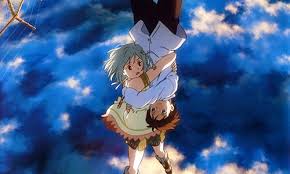
Many years after a mysterious cataclysmic event rendered the surface world uninhabitable a young girl named Patema (voiced by Yukiyo Fuji) lives as part of a thriving underground community in a dark and cramped realm of endless tunnels and shafts. Here people wear protective suits and lead modest, hard yet happy lives but Patema remains curious about the world beyond. Especially since her beloved mentor, Lagos (Masayuki Kato), disappeared long ago while exploring the outer realm. To the consternation of caretaker Jii (Shinya Fukamatsu) and devoted friend Porta (Shintaro Ohata), Patema keeps exploring the 'danger zone', an area forbidden by the elders. One day, startled by something scary in the shadows, Patema stumbles down a gaping hole only to emerge in a surface world where absolutely everything is upside down. Only it is Patema who appears upside down and floating in mid-air before startled schoolboy Eiji (Nobuhiko Okamoto). Together they come to realize their two very different civilizations co-exist on this planet and not everyone is happy about that.
Despite a premise remarkably similar to the Kirsten Dunst-Jim Sturgess flop Upside Down (2012) this feature length anime is the more compelling and thought-provoking work. Writer-director Yasuhiro Yoshiura specializes in idea and character-driven science fiction and Patema Inverted is on par with his outstanding robot-themed comedy-drama Time of Eve (2010). Establishing the off-kilter nature of the opposing upside-down worlds the opening credits run backwards (shades of Kiss Me Deadly (1955)!) over eerie images of broken buildings floating into the sky. It is a prologue as ominous as the one in Akira (1988) yet Yoshiura winningly counters the often dark dystopian drama with warm humour and a beguiling sense of wonder. In a charming conceit the 'camera' continually rotates to show just how disorientating each world appears to Patema and Eiji. Unlike too many live action science fiction films, the characters are convincingly alienated amidst their harsh future realms yet remain charming and likeable rather than overly dour. It is easy to care about Patema and Eiji and share in their horror and wondrous reaction to worlds each never knew existed.
Yoshiura and his animation team craft two plausible, detailed post-apocalyptic civilizations. One where so-called Inverts roam a subterranean realm yet remain remarkably chipper and gregarious, the other a sterile surface cityscape quite similar to the one in Divergent (2014). Introverted neurotic Eiji inhabits an Orwellian state that brainwashes kids into believing their way of life is superior to all else and the fabled Inverts are nothing less than scum of the Earth. As was the case with Divergent some aspects of this future society are a trifle absurd and implausible (e.g. citizens forbidden to glance at the sky) though easier to accept in a cartoon. The central romance is charmingly drawn as Patema and Eiji bond over the beauty of the stars and absent father figures. Being upside-down becomes a metaphor for cultures with differing points of view while the act of holding each other (at risk from floating into the stratosphere, Patema must walk balanced on Eiji's head!) embodies trust. Whereas most of the older characters talk incessantly of rules the young heroes boldly challenge the status quo making this a compelling companion piece to the recent run of teen oriented dystopian science fiction films. Nifty animation results in several impressive zero-G set-pieces particularly the third act twist that expands the plot into a whole other dimension.