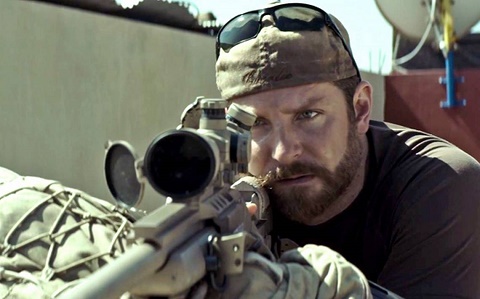
Chris Kyle (Bradley Cooper) was a sniper with the Navy SEALS in Iraq, and while there he would often find himself in life or death situations, with his own finger on the trigger and eyes to the rifle sights. These instances required him to make quick decisions, such as when he would see a woman and a child emerging from a side alley into the path of an oncoming American convoy and he was forced to make up his mind whether to shoot them dead or not: leave them and he risked allowing his fellow soldiers injury or death, shoot them and he had to answer to his conscience which was beginning to press upon him…
Apparently the real Chris Kyle had no such qualms, and as the sniper with the highest number of kills in that particular conflict he was a man who it could be said truly loved his job killing Iraqis, in fact he penned a book about his experiences which is where screenwriter Jason Hall based his script upon. Maybe if he and director Clint Eastwood had been more upfront about what Kyle was really like regarding his opinion on shooting people there wouldn’t have been so much controversy about American Sniper, which became a lightning rod of arguments both backing the war it showed and against. But were the detractors correct in that it was an unironic cheerleading work that invited the audience to relish every terrorist executed on the spot by Kyle?
Or was there something more subtle going on that the film’s champions were not acknowledging, as Eastwood and company saw in the story an example of how complicated the whole conflict had quickly become? Certainly when, for instance, the scene of Kyle seeing the World Trade Center felled in an attack is followed immediately by a scene of him practicing his rifle skills, it could be viewed as backing up the event with a violent reaction, or did it illustrate a knee-jerk one that mired the Middle Eastern region, not to mention the foreign forces trying to intervene, in a tragedy that proved impossible to resolve? The trouble was, you could take either point of view away from American Sniper, since just depicting the Iraq war was not necessarily an endorsement, but then again neither was it a criticism.
It was true enough the film was sympathetic to Kyle and what he went through, or what the film thought he went through (he could have had the time of his life over there for all we know), and that meant certain hackneyed elements were never far away, chief among them the hectoring wife back home, Taya played by Sienna Miller, who just tries to understand her husband and those things he’s seen that you people wouldn’t believe and so forth, but it was a thankless role for Miller because everything she had to contribute to the plot were complaints, and we’d seen this in countless war movies before, the ones which took it upon themselves to highlight the domestic angle at least. Not helping that was Eastwood’s apparent stance that the little lady was out of her depth in trying to relate to the life of a soldier.
Also not helping was the strangely colourless central performance, dialling down his accustomed charm to play it serious, but ending up cardboard and only allowing something approximating convincing emotion on occasion rather than all the way through. Hall’s script added business about Kyle entering the military to utilise his rifle skills at the age of thirty, so is referred to as an “old man”, when in fact it was Cooper who was too old for the role, as the actual person had been a few years younger than portrayed. Still, nobody expects utter accuracy in Hollywood biopics, unless you mean the accuracy with the sniper’s rifle of which the film was in no doubt, treating the ability like a superpower only the chosen few were blessed with, which may have been genuine if this was all we had to judge by. Really the main issue here was that you could read the movie precisely how you wanted and it offered you ammunition for that opinion, pro or anti; if it had embraced its musings over whether it was worse to kill with blind hatred or with guilt but for the supposed good, American Sniper would have been far stronger.
Becoming a superstar in the late 1960s gave Clint Eastwood the freedom to direct in the seventies. Thriller Play Misty for Me was a success, and following films such as High Plains Drifter and The Outlaw Josey Wales showed a real talent behind the camera as well as in front of it. He won an Oscar for his downbeat Western Unforgiven, which showed his tendency to subvert his tough guy status in intriguing ways. Another Oscar was awarded for boxing drama Million Dollar Baby, which he also starred in.
Also a big jazz fan, as is reflected in his choice of directing the Charlie Parker biopic Bird. Other films as director include the romantic Breezy, The Gauntlet, good natured comedy Bronco Billy, Honkytonk Man, White Hunter Black Heart, The Bridges of Madison County, OAPs-in-space adventure Space Cowboys, acclaimed murder drama Mystic River, complementary war dramas Flags of Our Fathers and Letters from Iwo Jima and harrowing true life drama Changeling. Many considered his Gran Torino, which he promised would be his last starring role (it wasn't), one of the finest of his career and he continued to direct with such biopics as Jersey Boys, American Sniper and The Mule to his name.




 Display comments