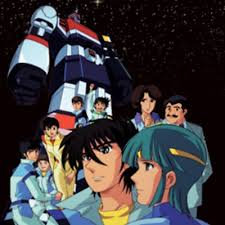
In the far flung future of 1999 humanity begins colonizing the stars. Takeru Myojin (voiced by Yuu Mizushima), a brave young man with uncanny superpowers, is part of the Cosmo Crushers, a space search and rescue team including gal pal Mika (Youko Kawanami) and buddies Kenji (Hiroya Ishimaru), Akira (Yoku Shioya) and Naoto (Hirotaka Suzuoki). On a routine mission Takeru suddenly receives a psychic transmission from vast alien entity Emperor Zule (Goro Naya). Zule reveals Takeru is not human at all but a sleeper agent for the Gishin race bent on destroying planet Earth. Spurning Zule's offer to rule the universe by his side, Takeru confronts his Earth parents and learns his real name is Mars. And, this being an anime, he has a giant super-robot named Gaia with which to defend his adopted world. Meanwhile Zule grooms Takeru/Mars' long-lost twin brother Marg (Yuji Mitsuya) to command a powerful space armada on his behalf. What no-one knows is Marg is in secret psychic contact with his twin with whom he hopes to destroy the evil Zule.
Mitsuteru Yokoyama was the manga artist that pioneered the giant robot genre so beloved in Japan with his seminal Tetsujin-28 (1963), released in animated form in America as Gigantor. Eventually the even more influential Go Nagai refined Yokoyama's concept of the remote-controlled robot into the so-called super-robot sub-genre where heroes could actually pilot steel behemoths like a fusion of spaceships and samurai armour. The huge popularity of Nagai's robot epics Mazinger Z (1972) and UFO Robot Grandizer (1975) prompted Yokoyama to craft his own super-robot saga with God Mars albeit self-plagiarizing a concept or two from his earlier landmark science fiction epic Babel II (1973).
If there is one thing super-robot anime are famous for (er, that is aside from featuring giant robots) it is angst-ridden, child viewer-traumatizing, melodramatic plots. Typical stories pit son against father, friend against friend or, in the case of God Mars, brother against brother. Mere moments after the twins' tearful reunion on a distant planet, Marg gets abducted by Zule and brainwashed to serve as his 'ultimate weapon.' He also gets a sexy female sidekick called Rose (Rumiko Ukai) who feeds Marg a pack of lies turning him against Mars. Rose has her own tragic story arc as she ends up falling in love with Marg, a sensitive soul who would much rather play with his pet bird than command an invasion force against Earth. One of the most overwrought anime melodramas of all time, God Mars bombards the viewer with relentless tragedy: parents shot dead in front of their children, lovers wrenched apart, a robot armed with an anti-proton bomb set to end all life should the hero die just to keep Earth out of the invader's hands! Oh, and Marg's bird gets crushed by a Gishin goon. Jeez.
Nevertheless it is a well paced movie with relentless action, compelling characters, heady drama and a beguiling dreamlike atmosphere. Eye-catching animation enhances excellent space combat sequences and impressive images of global destruction on par with the far bigger budgeted Harmagedon (1983). Parts of the film convey a near-Lovecraftian sense of horror, as in the climax where towering Emperor Zule sneers at mankind before unleashing the apocalypse, but lest things get too heavy there are enough pounding disco interludes while Mars gazes soulfully into space to make this almost rate as a musical. Unsurprisingly condensing a sixty-four episode television series into a ninety-five minute feature results in the odd plot gap and continuity hole but Yokoyama's core themes of brotherly love and self-sacrifice remain coherent and even moving. Gaia itself is not one of the more memorable robot designs in anime history though it does sport a surprisingly welcoming smile! Plus the twist ending finally explains why this was not titled Giant Gaia. Six years later a sequel arrived with God Mars: The Untold Legend at 17 (1988) before the saga was remade as an OVA series in 1994 supposedly more faithful to Yokoyama's original manga.