It is a hot and steamy night and the revivalist preacher (Bill Rogers) is holding forth in his tent with an impromptu congregation of the faithful all hanging on his every word, boomed from the makeshift pulpit about how he wants any sinner present to repent, and the best way to do that is to give him their money though he doesn't mention he will be keeping it for himself. But two people stand at the back of the tent surveying this scene, Daniel (Lewis Galen) and his mother who are notable for being the only African-Americans there, and when a certain woman appears and walks up the aisle, the old lady warns her son away from setting eyes on her, for she is Emily (Eleanor Vaill), the local shanty tramp…
It’s not necessary to be too familiar with the Florida lingo to understand what that meant, as the actress summed it all up in her walk and lascivious looks, in what would become one of the defining efforts of the early trash cinema out of the United States. The people involved with this had connections to all areas of the grindhouse and drive-in circuits, for a start it was produced by the opportunistic K. Gordon Murray, who saw nothing wrong in distributing dubious adult entertainments such as this along with cheap fare for the kiddies in the shape of redubbed and retooled Mexican movies, it was all about making the profits for him rather than the art of the business, and it certainly showed.
The Murray name on your evening’s diversions (or matinee’s if you were under twelve years old) was an unerring indication of absolute tat, but even he could occasionally concoct something of interest, and Shanty Tramp has gone on to be the most notorious work for the grown-up market that he put his moniker to. Not because it was any kind of masterpiece, but because it encapsulated everything about its low budget grime that for many was the epitome of this era’s screen sleaze, that era being from the nineteen-sixties to the mid-seventies, often claimed to have been released in 1967 but rumoured to have been shot quite some time before. The most prominent element denoting its trash origins was the fact that leading lady Vaill (here under the nom de guerre Lee Holland) was patently hired thanks to her willingness to take off her top.
She wasn’t classically attractive, but had a certain toothy appeal, though what truly marked her out was her style of acting, which again wasn’t exactly accomplished, but in such scenes as where she is found in post-coital embrace with the reluctant Daniel (she was just too irresistible for a decent man like him) she starts yelling that he has raped her (he hasn’t, it was consensual), and when the Sheriff’s lynch mob arrives, she goes for the Academy Award of tawdry performances. That wasn’t all as we had quite the cast of rogues here, with Daniel the only virtuous character aside from his mother, and they meet unfortunate fates thanks to Emily’s machinations – she’s not deliberately trying to get anyone killed, she’s just so twisted she can’t help herself when these opportunities arise.
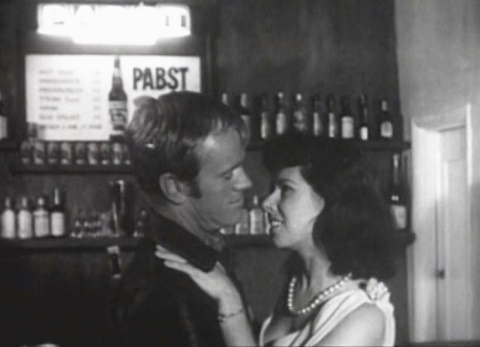
You can just about see Daniel’s ordeal as a result of giving in to his libido’s demands, so he is in effect punished, but you never think he deserved it, and his mother certainly doesn’t deserve what happens to her. Oh yeah, and there’s a biker gang roaming around, the leader of which is a budget bad boy Tab Hunter type called Savage (Lawrence Tobin) who tries to rape Emily (for real, this time) and gets a knee in the nuts for his trouble; call it a consequence of subjecting the audience to his dancing in the barroom scene. As for the preacher, he appears to be a result of the filmmakers setting their sights on the hypocrisy of small town America, Baby Doll-style, people who would happily hand over their earnings to hucksters in the Jimmy Swaggart mould, while condemning people who were really no worse than they were, though in Emily’s case we are plainly intended to regard her as beyond redemption, even by the preacher who fancies getting acquainted with her. That it ends as it does demonstrates quite some cheek, and also why this was so controversial wherever it played at the time. There are other words to The Saints Go Marching In, you know.