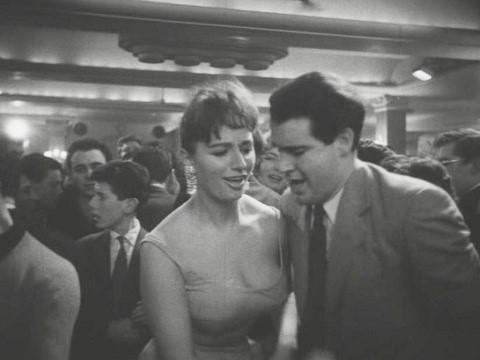
Johnny Lawrence (Philip Gilbert) gets up this morning to answer the door to the postman, who has a recorded delivery for him, but the letter does not contain good news: it’s another rejection for his idea for a rock ‘n’ roll television programme, and he screws it up and throws it away in frustration. His usual job is as a disc jockey, and he estimates to his good friend and colleague Pete (Colin Croft) that he must have played at least two thousand records in his five years on air, but he still hankers to break into television production especially now the modern music his listeners like is so popular…
Rock You Sinners has the distinction of being the first British rock ‘n’ roll movie, all fifty-seven minutes of it, and was brought to the screen by the machinations of notorious low budget producer E.J. Fancey who would fill up the lower halves of double bills with quota quickies barely interested in the potential of film as a medium, never mind an artform, distinguished by their consistently cheapskate appearance, the epitome of the timewaster when you were waiting for a better movie to start. In this case his wife B.C. Fancey was the producer, and his daughter Adrienne Scott was the leading lady, as she was often in these efforts, though predictably as far as stardom went she never escaped the ghetto of her father’s works.
What Adrienne did do was strike out as a distributor, becoming the first British woman in that field and most famously brought Emmanuelle to the United Kingdom in the nineteen-seventies, but she still wasn’t the most celebrated member of the cast of Rock You Sinners. Neither did that high profile go to any of the musical acts, and after experiencing what these Brits thought was rock ‘n’ roll they may well have been glad to put it behind them. Nope, the best known face in this belonged to Jackie Collins, who played the girlfriend of Pete, imaginatively called Jackie, although perhaps calling her face well-known was a little misleading for this was made before she had the cosmetic surgery on her nose.
Therefore you may be forgiven for not recognising the future author of The Bitch here, because a smaller hooter really did make a difference to her looks. As it was, at least she came across as the most accomplished of the cast as far as thespianism went, but that wasn’t saying much given how terribly polite Johnny and company were, about as far from the rebellious spirit of the cultural phenomenon as you could get. You did hear Heartbreak Hotel, but even that was halfhearted at best when the singer was patently not Elvis Presley but a little blond bloke with a quiff and doing his utmost to sell a song that had become a benchmark, only not in this version. Director Dennis Kavanagh betrayed his lack of confidence by having the actors stand around laughing at him.
Even so, it was the best song here, as others proved to be of the calibre of a version of Oh I Do Like to Be Beside the Seaside crooned to a swinging beat, just so they could make the connection between sticks of rock, that tasty seaside treat, and, er, rock the music. Even that wasn’t quite as bad as Rock with Rory, Rory Blackwell that was, demonstrating enthusiasm if not skill, as were his co-stars, or Joan Small whose ditty doesn’t have any love for the form at all, and don’t get us started on the calypsos from George Browne which weren’t even rock in the first place, but were popular at the time, so in they went. The biscuit was well and truly taken when Pete had a solo number in Jackie’s music store, possibly the worst ever in a subgenre of musicals that were often cheap and cheerful, or cheap anyway, sounding like its creator was approximating rock from a description he read in a tabloid newspaper. Make no mistake, this was dreadful, but so dedicated to its bastardisation in pursuit of an easy profit that you grudgingly admired its gall.