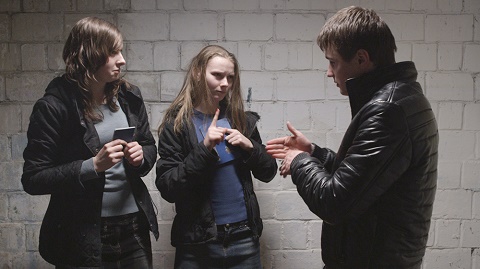
Sergey (Grigoriy Fesenko) is a deaf teenager who is attending a new boarding school, and today as he arrives he gets directions from a woman at the bus stop and heads over to the main building, where he finds he cannot get in because the doors are locked. A cleaner signals to him to go around the back, which he does but in such a long route that by the time the assembly for the start of a new term is over, everyone has dispersed. He does manage to find the office of the principal, who gives him instructions of where he should go next, and soon he is in a history class learning about the European Union with his fellow pupils, who are also all deaf. But there is a sinister, hidden world to this school…
The Tribe was heralded as the first film to be made entirely in sign language, though it wasn’t, for there had been an American horror movie from the nineteen-seventies called Deafula which had its dialogue relayed in that manner of communication. The fact this wasn’t a horror movie should not dispel any fears this was actually free of disturbing scenes, for director Miroslav Slaboshpitsky was keen to make us clear in no uncertain terms that those who were disabled by lack of hearing could behave just as badly as those who were not, and he filled his story with scenes of bullying, violence, graphic sex (though obviously faked), and even threw in an abortion scene (also obviously faked, though no less unpleasant for that).
He favoured long takes, which made this resemble Alan Clarke’s harrowing short film Elephant, or more likely the Gus Van Sant film of the same name which was inspired by it, also set in a school, though The Tribe did not depict the lead up to one tragedy in particular, it was more an ebbing away of any kind of moral basis for Sergey’s actions as he, as the new boy, joins the criminal gang who run the students’ lives and steadily graduates to further acts of violence and depravity, which included rape in a manner reminiscent of Alex from A Clockwork Orange. One big difference? In the Stanley Kubrick work, his antihero is redeemed partially by his love of classical music, yet here the boy was unable to find that outlet so all we heard was natural sound, no music whatsoever.
Quite who this was for was a conundrum in itself, not being the most flattering study of non-hearing people so would they want to see themselves shown up as pimps, prostitutes and thieves, or would it be liberating to watch the cast – who were all deaf – break so many rules of society? One would hope the character’s actions wouldn’t be endorsed by anyone, be they in the same physical condition or not, leaving the director’s love of sticking with the wrongdoers for five or ten minutes at a time as they went about their nefarious business as unsettling as you had to assume he intended them to be. That did not necessarily mean it was going to be an enjoyable experience, but then again it could be that we were being lectured on something or other, in which case Slaboshpitstky needed to make himself plainer.
There were times – most of the film, in fact – where you pondered what the point of showing the deaf to be horrible people in spite of the poor hand life has dealt them regarding their handicap, was it to render them equal to the non-afflicted in their eyes? With not one instance of a sense of humour unless you gravitated to the bleakest laughs possible, The Tribe was a grinding set of miserable scene after miserable scene, dragging the teens through such grim circumstances that it was impossible to find anyone to sympathise with. The only way you might be able to do that is when one of them is abused by another, so you would briefly feel sorry for the victims, but even then the film appeared to be punishing its inhabitants with such Old Testament lack of compassion that you began to suspect we were supposed to think they deserved their dreadful fates. The lack of understandable language was not so much of a barrier as you might think, the plot was simple enough, but the lack of anything to like was a bigger issue. A film for those who don’t think cinema should bother with frivolities such as enjoying yourself.
Aka: Plemya
[Metrodome's DVD has three observational featurettes as extras.]