Here is a gold mine in Brazil, where countless men have set up an operation that they hope will make them rich, but in the process has simply destined them to years of hard labour as they toil in the mud, stretching far as the eye can see as they collect sacks full of earth and bring them up to be panned for gold specks and if they’re lucky, a nugget. The huge exertion they expend in this workload is hardly going to compensate for the small amount of income they will actually gather, but there are places on Planet Earth counting on them uncovering the precious metal, places with far more comfortable conditions than the region where, say, a man can be knocked out cold in his endeavours and must be borne on the backs of his fellow workers to seek medical attention…
Is that really worth it, asked director Godfrey Reggio? Once again he was pointing the finger at the First World on behalf of the Third World, as before he had with his breakthrough effort Koyaanisqatsi, and whatever you thought of his message and themes, there was little doubt of the skill and vision with which that film had been assembled, its succession of vivid imagery complemented by the Philip Glass score playing constantly on the soundtrack. Glass was back for this too, but had to defer to occasional blasts of traditional, ethnic tunes which not everyone was going to be pleased about since that Glass music was a big part of what made the original in this trilogy flow.
Yes, it was a trilogy, and even those who were less keen on Powaqqatsi had to admit it was a hell of a lot better than the third part which arrived almost fifteen years later, the disastrous Naqoyqatsi which lapsed into horribly dated computer graphics so often it was a wonder it ever was released. An aspect that may have given fans of the first one pause was the parent company logo: where before you had the endorsement of Francis Ford Coppola, here it was the Cannon company producing it, their name synonymous with regular trash and stupidity during this decade. That said, the Go-Go Boys did put their name to works by respected directors who could not raise funds anywhere else, such as Jean-Luc Godard or John Cassavetes.
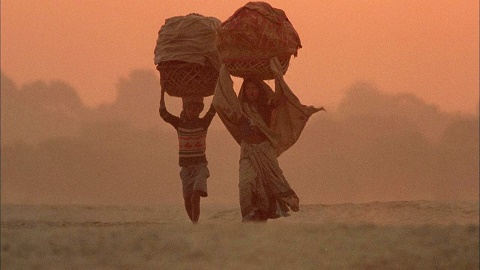
Nevertheless, in light of how much of an impact Koyaanisqatsi made at the beginning of the eighties, it was surprising that it was the not much respected Cannon putting up the budget, so more power to them – perhaps it was they who suggested the Israeli footage. Reggio and his crew had travelled around the globe to capture clips of daily life in various developing countries, always with a view to apparently making the Westerners watching shift uncomfortably in their seats when they twigged their lifestyle was very much reliant on the world’s poorest communities toiling hard for their pampered existences, perhaps deliberately failing to acknowledge that not everyone in the developed world was exactly living in the lap of luxury. It was this sort of narrow focus that tended to give fuel to Reggio’s detractors.
They would accuse him of hypocrisy when as a director he was using the very latest technology to shoot and edit his films, technology that had to be invented before he was able to mount his epic complaining sessions, and wasn’t he being patronising to both sides of the financial divide on Earth if he thought the poorest were better off with their simple lives and the wealthiest had no idea of what it took to keep their lights burning and televisions running? After all, it was not as if there was a blanket blackout on news from the nations who were suffering more than the others, there was a reminder every time you turned on the news or picked up a paper. The title is explained as meaning an entity which consumes others in order to prosper and survive, but it was maybe best to allow the mix of visuals and music to work in tandem – Reggio had lost none of his skill in that area – than to start to pick apart the moral we were intended to take away. All those “pure” children representing their exploited societies was a tad exploitative in itself.