Lili (Zsófia Psotta) is a young girl in Hungary who dotes over her pet dog Hagen, but nobody else likes him much, in fact there's a distinct lack of love for the four-legged friends in the city, with many abandoned with other strays to be driven off the streets and into the dog kennels where they will be destroyed if they are not claimed. Lili fears Hagen will be taken away too when she has to live with her father Daniel (Sándor Zsótér) who is very reluctant to take her into his apartment while her mother is away on business if the dog will be there as well, and the more the animal causes trouble for him, the more he wants to drop him off at a location it won't be able to find its way back from...
White God was often mentioned as a variation on one of those vintage revenge of nature movies, a strain of horrors and thrillers that saw the animal kingdom getting its own back on humanity for the ills it had visited upon it, both actual and perceived by the filmmakers. After kicking off with Alfred Hitchcock's The Birds in the mid-nineteen-sixties, the seventies were the true heyday of such tales, but in the twenty-first century there was a belated revival when Rise of the Planet of the Apes was a success, and there was more than one observer to note the way the plot unfolded here was similar to the arc of that blockbuster franchise entry. There was a difference, however: this was an art film.
And it might have been more effective if it had embraced its inner horror flick and really pulled out the stops for its grand finale, a series of anarchic sequences that took up much of the second half. Before that we were offered a selection of dogs=good, people=bad scenes, as everyone aside from Lili is bad tempered and hostile, and even the girl is not exactly a little ray of sunshine when she's not with Hagen. We see her playing trumpet in a school orchestra, and when the pooch interrupts excitedly, it's the last straw for Daniel who takes him to a quiet part of town and leaves him there, an anguished Lili having to call uselessly from the back seat of the car as the dog fails to follow after when the vehicle speeds away.
So begins his real adventure, which alters his personality when he is forced to enter a dogfighting scam, pitted against his fellow hounds in a manner suggesting humankind has perverted the laws of nature by encouraging such things for sport. Yet tonally, a strange thing happens, for the further Hagen is dragged into the depths of despair, the more upbeat Lili's life grows, as she bonds with her father and the upcoming concert is something she is truly looking forward to. There was evidently some kind of allegory director and writer Kornél Mundruczó was alluding to, though precisely what that was wound up muddled in a lot of revolutionary themes, so whether it was about the treatment of immigrants or more obviously the treatment of actual dogs was up to you.
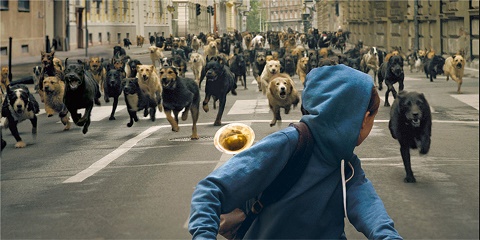
The trouble with these stories depicting a revolt is that it tends to tar everyone on the receiving end with the same brush, and it was only the presence of Lili who gave us a note of optimism that whatever factions were actually intended would ever learn to get along and solve their problems and differences. Alternatively, you could forget all that and appreciate the thrills of watching dogs going nuts and organising themselves into a hundreds-strong army, charging down the streets and attacking anyone who got in their way, though their ultimate goal was rather obscure - where did they think they were going, for a start? What was not in doubt was the training of these (mostly shelter) animals was very effective indeed, and the shots of them overrunning the city were the best in the film, indicating that perhaps this should have concentrated on them, Plague Dogs style, instead of bringing in a lot of Lili's personal life which began to feel superfluous when it was Hagen who was having the most dramatic experiences. Interesting, but with a few tweaks it could have been great. Music by Asher Goldschmidt.