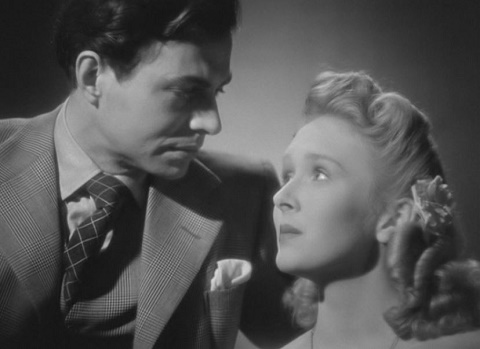
Only one year ago one of the mistresses here at this exclusive girls’ school disappeared while walking on the Yorkshire moors, or at least that’s what the official verdict was since her body was never found, presumed lost in the bogs that populate the wilderness there. But her friend Marian (Joyce Howard) has never quite given up hope of finding her alive, and now the term has ended she and the games mistress Doris (Tucker McGuire) are going to head up north to see if they can uncover any more evidence, much to the chagrin of their stuffy superior who Doris likes to tease with her modern approach to womanhood. Once on the train, however, she is abashed to find Marian has booked them into a Ladies Only compartment, though that does not stop her from coaxing a dashing doctor, Barry (John Fernald) in to see her with a pretend faint. But more serious situations await…
In the Britain of the early nineteen-forties, as far as cinema went escapism was very important, so of course there were the propaganda movies where every star from Leslie Howard to George Formby took on the Nazis and won, but audiences were also seeking to forget those troubles for a while, and therefore in parallel to the war movement were such items as costume drama that the women could swoon over. In theory, at least, but the heroes of these were often antiheroes who would be all the more alluring to the female moviegoers for their aloofness and cruelty, a demeanour that only the purest of hearts could break down to find the loving character beneath the brooding exterior. Quite why these became popular is worth a psychology essay in itself, but popular they were.
The Night Has Eyes was in the strain of those, only it was set contemporarily, but there was a duo of actor and director who were among those responsible for setting off the craze, star James Mason and director Leslie Arliss. For Mason, playing the cad with hidden depths was his ticket to bigger and brighter things as he became internationally popular, proving his talent went further than glowering good looks and silky smooth tones, though for Arliss these works were the highlight of his career as it was all downhill thereafter, apparently thanks to his falling out with Alexander Korda, one of the most powerful men in British film. He ended up directing television, traditionally the rest home for creative types who could not persuade any producers to allow them to helm any movies for many years.
Back in 1942, this duo were just starting out and this was a notable hit for them, a curious mix of romance, horror, comedy and weather-lashed setting. The comedy was mostly given over to McGuire, an American actress seeking prospects overseas, and though she never became a big star she proved she had the talent here, lighting up the screen with her sassy persona and missed when she was not present. Yet really the story belonged to Mason and Howard when Marian and Doris are rescued from a fierce storm while hiking one night, and composer Stephen takes them back to his isolated country house, its lonely location a metaphor for its owner's determination to stay away from his fellow citizens after being disgusted by them when he suffered greatly during the Spanish Civil War – the Second World War is not much mentioned here.
But there was a message, much as the same year’s Casablanca had, that no man is an island and now the globe was in crisis you couldn’t just step back and let everyone else get on with it, and so it is that Marian falls for the moody outsider with a view to bringing him back to the land of the living. Ah, but here’s where the horror enters into proceedings as not only is this old dark house territory we are well and truly steeped in, but Stephen is a werewolf! Well, not really, but he may as well be for every time the moon is full he must kill something (or someone?) to snap out of his fit, and we are asked to ponder whether he murdered the friend Marian lost the previous year. With a hidden room, a cheeky monkey, deadly sucking mud, angora rabbits, a housekeeper (Mary Clare) forever switching between matronly kindness and dire warnings, and a handyman (Wilfrid Lawson) who tends to creep about and go off on weird tangents, The Night Has Eyes enjoyed a lovely atmosphere of vintage strangeness, easily the equal to the equivalents coming out of Hollywood at the time and with a neat British spin on the clichés. Music by Charles Williams.
Aka: Terror House
[A gallery is the sole extra on the Network DVD, but fans will be delighted at the pristine print.]