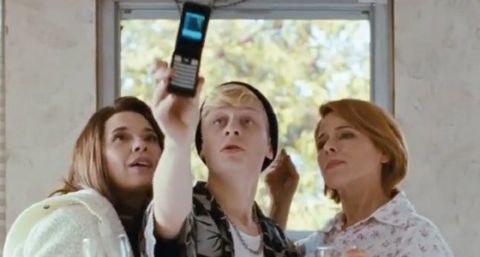
Diane Deprés (Anne Dorval), known as Die to her friends, has a problem, and his name is Steve (Antoine-Olivier Pilon), who happens to be her teenage son. He has been in and out of trouble ever since his father died, an event that tipped him over the edge psychologically, and now thanks to new legislation if she doesn't wish him to stay locked up in an asylum she must look after him herself, at home. Die is pretty volatile as well, so when she goes to fetch him from the institution he was already attending but has to leave because he set the place on fire, the sparks begin to fly emotionally. However, she still loves her son, and must reconcile that fact with the worry he is too much to handle...
Writer and director Xavier Dolan won the biggest acclaim of his career up to that point when he released Mommy, an example of his one-man drive to offer actresses vital, non-stereotypical roles in an industry that tended to cast them as victims no matter what age they were, and once they had reached their middle years they were lucky to get anything much of interest at all unless they were one of the megastars. Dolan's two recurring stars in much of his work were Anne Dorval and Suzanne Clément, and to reward their loyalty they were offered two plum roles here as new pals who find themselves bonding over Steve's bad behaviour, Clément's Kyla who lives across the street.
She has a secret sorrow of her own that the film keeps quiet about, though the clues are there, but whatever has happened to her she has a stutter that has arisen since her trauma, which gives her the interesting position of relating to Die's mothering issues and Steve's mental unbalance, so sure enough she manages to bring them together, if only for a while. They're both a handful, but maybe Steve even more as Dolan crafted the part to grate on the audience's nerves as much as possible as he has no idea of decorum or restraint, he simply goes at people and life in general like a bull in a china shop. For this reason some viewers found themselves wishing Steve would be locked up, as much for his own good as for their peace of mind for the rest of the movie.
For Dolan, this was all about the intensity of motherhood, not so much the beginning of it when the offspring is still a child, but the later stages when the personality is developed and might not have turned out as sturdy as you would have wished. Obviously nobody goes through life avoiding anything ever bad happening to them, but for Steve this has hit him worse than many, and the loss of the parent he adored leaves him with mixed feelings about the one who is left. Die senses intuitively what the tragedy has done to her son, but struggles with the way it results in even more pressure on herself, testing her love to the limits in scenes you could imagine the director urging his small cast further to fresh heights of histrionics - no doubt about it, this was a loud film.
To amplify these raging sensations he shot the production in 1:1 ratio, not even Academy which is 4:3, which could take some getting used to but made sense stylistically, and was all the more effective for indicating when the characters could be more hopeful about the future when the screen opened out into 1.85:1. It could be regarded as needless fiddling with the technical side when the actors were doing a perfectly good job of conveying the tone of each sequence, yet on watching the effect it was appreciable how the claustrophobia was relieved for a few minutes at least. There was no doubting Dolan's sincerity, even if his control was a tad slippery, allowing the emotions to reach operatic heights of vehemence when the quieter moments did not exactly represent much of a contrast. We can tell Steve is psychologically disturbed all right, but at over two hours you could legitimately wonder if Dolan was trying to wear us down until we were begging in submission rather than drawing us deeper into the tale of dysfunctional existences scrabbling around for their last vestiges of optimism. Music by Noia.