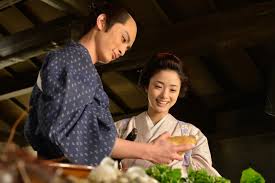
Haru Funaki (Aya Ueto), a young maid serving a feudal lord during the Edo period in Japan, has remarkable taste buds and is an outstanding cook. Outspoken by nature, Haru has already lost one husband through divorce leaving her a virtual social pariah yet the Lady Shinyoyin dotes on her fondly, admiring her remarkable culinary abilities. With a single taste Haru identifies every single ingredient in a complex soup prepared by the top samurai chef in the Kaga region. Bowled over by Haru's talent, he entreats her to marry his son Yasunobu (Kengo Kôra). At first Haru declines, since Yasunobu happens to be some years younger, yet faced with an uncertain future and intrigued by the opportunity to cook for the wealthiest estates in Kaga, she relents. Unfortunately it turns out Yasunobu is indifferent about his new wife ("Women are like potatoes. Peel them and they're all the same, no matter where they grow"), having lost the real love of his life to his best friend, and values the sword above the kitchen knife. Aghast to learn her husband has neither the talent nor inclination to uphold his family's foodie tradition, Haru resolves to set him straight on the art of cooking.
As the title says, this is based on a true story. During the Edo period so-called 'kitchen samurai' specialized in food much as other classes of samurai would specialize in archery, horse-riding or swordsmanship. In the context of such a male-centric society, A Tale of Samurai Cooking: A True Love Story pleasingly highlights the important contribution of one gifted, outspoken young woman to a family legacy that went on to influence the entire subsequent history of Japanese food culture. Food as philosophy is a theme underlining a selection of choice international movie morsels from Babette's Feast (1987) to the Ang Lee favourite Eat, Drink, Man, Woman (1994), Chocolat (2000), and the German-made Eden (2006), a genre once savoured by foreign film gourmands though increasingly derided by non-foodies less taken with hackneyed life lessons dispensed through cookery.
While Yuzo Asahara does not achieve the same heady brew of Juzo Itami's hilariously spaghetti western-styled food-as-sex analogy Tampopo (1987) (still Japan's premier contribution to the food as philosophy genre), to his credit the film manages to touch on the many nuances of food: as an expression of artistry and emotion, a sign of social status, even a form of political protest. For the most part it is a gentle comedy of manners interlaced with a beguiling love story that yokes considerable charm in showing Haru gently yet firmly coax macho samurai Yasunobu into honing his skills and taking pride in his role as kitchen samurai. In a way the film is less concerned with food per se than it is with duty, a very Japanese theme. It slots into a long tradition of Japanese stories that argue how by diligently applying one's self to a task, investing passion and heart, one can transform the seemingly trivial or demeaning into an act of great significance or consequence. Such diligence is the mark of a true samurai or woman for that matter. After a relatively lighthearted first half the message grows particularly resonant later when events take a darker turn. The death of the Lord of Kaga and the rise of anti-reformists sparks a downturn in the fortunes of Yasunobu's friends. While other samurai plot sedition, Yasunobu balks at the indignity of cooking for his oppressors forcing Haru to risk everything to dissuade him from joining an assassination attempt to prepare a lavish banquet for the despised Tokugawa lords celebrating Koga cuisine. Aya Ueto, who ten years prior headlined Ryuhei Kitamura's visceral ninja girl actioner Azumi (2003), gives a rounded, affecting performance that persuasively illustrates the wisdom in feminine values over masculine values at several key points. Warmhearted and humanistic the film should appeal even to those less enamoured with Japanese period fare, emphasizing a sweetly romantic tenderness and subtly goofy humour that disproves the idea all samurai movies are stoic and solemn.