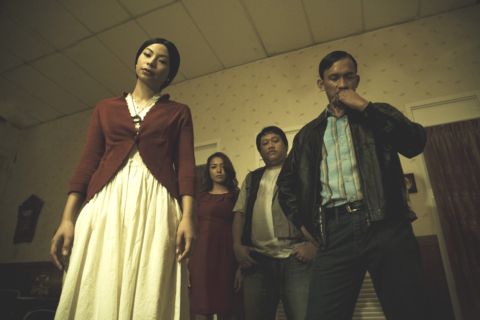
Ladya (Julie Estelle) has been feeling estranged from her brother Adjie (Ario Bayu) and her sister-in-law Astrid (Sigi Wimala) for some time, but now they're not only about to have a baby but emigrate to Australia too, so it's now or never if they want to make up and let bygones be bygones. The trouble with that is Ladya remains cold towards them, and though her sibling has made moves to build a bridge between them before his long absence, she is reluctant, even at the restaurant she works at where Adjie has specifically visited with Astrid and his friends. As it turns out, there is a scuffle with some yuppies who try to intimidate Ladya, so the evening ends with the party hastily making plans for home. But who's this in the road?
It's someone you shouldn't give a lift to, as in a horror movie fashion you should be wary of any stranger who invades your personal space, even if it's they who appear to be at a disadvantage. By this stage in the genre, just about everyone seeming innocent other than the protagonist had some ulterior motive or other, and it was very much the course of events that played out in Macabre, the debut feature of Indonesia's Mo Brothers. They would go on to bigger projects, but this was where they got their start just as The Raid movies generated interest in their country's cinema, specifically their horror and action movies that the rest of the world woke up to, or at least those willing to give them a chance did.
World cinema had come a long way since the more accepted by the cognoscenti sensitive rural dramas that they became associated with, and directors like these guys demonstrated how savvy they and their contemporaries had become by melding features of Western movies with the more indigenous material that offered that particular flavour of their society. Some described Macabre, which was based on their short subject on a similar theme, as indebted to the then-recent French strain of gory flicks, but you could trace them all back to Tobe Hooper's Texas Chain Saw Massacre which set in stone the typical slasher movie premise of young folks terrorised by unknowable assailants.
In fact, so indebted were the Mo Brothers that there were few surprises, never mind shocks, in Macabre for seasoned fright fans, meaning if you were familiar with the conventions then you could more or less guess where the movie was heading from the first few minutes. Only the directors were keen to keep their powder dry for the opening half hour, either building up the suspense or dragging out their plot which was obvious for too long where it was heading, and when it arrived at the mayhem you would have a sense of watching the actors going through motions that were very recognisable from other films. Others films in the so-called torture porn style, that was, as the group of young folks are put through the wringer.
Not literally, although that's about the only body-mangling indignity that doesn't happen to them, but if you simply wanted all that violence and a heroine you could keep your fingers crossed would survive to the end to get her own back, then the Mo Brothers were not about to disappoint you. Really it was only the location that set Macabre apart, as it was otherwise as if the directors had a checklist of brutality and creepiness to work through; that said, as their chief villain and head of the twisted household Ladya and company wind up at the mercy of, elegant Shareefa Daanish was very memorable, and a beacon of interest in what was otherwise by the numbers. Utterly composed, talking softly, she gives off an impression of someone you do not want to mess with, and if she decides she wants to mess with you then you should be worried. You just know that large hairpin in her bun will come into play eventually. Nothing revolutionary aside from its origins, then, but if the sound of a revving chainsaw be music to your horror fan's ears, dive in, you could do worse. Music by Yudhi Arfani and Zeke Khaseli.