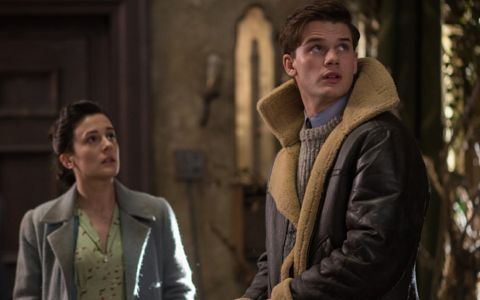
London 1941 and the Blitz is underway, with the Nazis bombing Britain as part of the Second World War, leaving citizens like Eve Parkins (Phoebe Fox) having to huddle in bomb shelters while the onslaught continues, or in her case end up in the Underground station nearest to her with the other Londoners taking refuge as the loud booms sound overhead. Tonight is a particularly harsh one for Eve's street, as when she emerges the next morning she finds it has been almost reduced to rubble, making her half-glad she will be leaving the capital behind for the next while. She is a schoolteacher, and has been entrusted to take evacuees to the countryside to keep them out of harm's way...
If The Woman in Black proved anything, it was that Daniel Radcliffe could have shown up in almost anything in a starring role, and his Harry Potter fame would have ensured that there was a big enough audience for something in a supernatural vein. Oddly, that wasn't the case with the more recent horror Horns, suggesting the effect was wearing off, but whatever the case he elected not to show up for the sequel to his biggest success after the franchise one. This left, not another hugely identifiable star to step into the part, but a whole new story devised by Susan Hill - author of the original novel - to be carried by the relatively unknown Phoebe Fox, which had the movie's profile lacking.
All it had really was the Woman in Black title to give it brand recognition, and aside from that there was little reason for would-be fans to check it out unless they simply had to see every current horror movie out there, in which case they would find a work exceedingly indebted to many others, jump scares and all. Well, there was one thing to make it stand out, and that was director Tom Harper's distinctive lighting, or rather his complete lack of lighting, leaving many viewers peering into the gloom trying to work out what the hell was going on. Seriously, about half the movie took place in near-pitch darkness, which was not so much creepy and more frustrating if you were genuinely interested in following the plot.
Some of this was excused by the script's faithful period qualities, since during that war there was a blackout and it was meant to be dark so the Luftwaffe wouldn't be able to make out its targets, and it was true Harper and his team tried to be as authentic as possible in its trappings, all very well if you could actually see what they were in the first place. Yet in the main the results were so obscure to look at that losing patience was an option all too available for the majority of those watching, and Angel of Death was judged to be a failure by those who might have been more keen on it if some care and attention had been given to the definition of the film other than "keep it dark!" It was not so much atmospheric as it was easily rejected for its lack of clarity.
If there was one thing Hammer knew about it was sequels, as they had built their reputation on a series of such things back in its heyday, although come its revival the studio were not so enamoured with bringing back the classic creatures they had made their names with, preferring a more modern approach. Whether that was a good idea or not, the fact remained they were coming across as more trend followers than trendsetters this time around, and the original Woman in Black (original to cinemas, that was) displayed a better sense of how to command the market than anything else they had released up to that time, and indeed up to the point of this follow-up. Fox was fair as the normal centre of the action necessary for the strangeness to revolve around, Jeremy Irvine was fine as well in a rather two-dimensional role as the pilot who operates as Eve's saviour, but pity poor silent Edward (Oaklee Pendergast) who was the conduit to the spirit world, losing his parents in the first couple of minutes, ending up with the bed under hole in the ceiling, and so on. Lucky he couldn't see much, really.