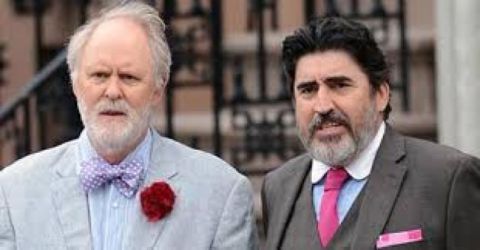
It's a big day for Ben (John Lithgow) and George (Alfred Molina), and as they wake this morning they make sure to dress to the nines, then head off to the location of their wedding ceremony: they have been together for thirty-nine years and now their love can be recognised by the law, they are to take full advantage of that. The ceremony goes well, and the reception back at their tastefully furnished apartment goes even better, with everyone having a fine time and Kate (Marisa Tomei), wife of Ben's nephew Elliot (Darren E. Burrows), delivering a touching speech by way of tribute to the newlyweds. But almost immediately there is a problem, and though their love remains strong the couple have to split...
It just so happens that in 2013, when this was set, there was no provision for George to keep his job at a Catholic school where he was the music teacher and choirmaster, for he had signed a morality clause which regards him getting married to a man as a breach of contract. In this day and age it seems incredibly backward that someone could lose their job for falling in love with no controversy other than what the school create, but George has to swallow his pride and leave, which means he and his husband are without half their income, maybe more, and as Ben relies on the funds he gathers from his artwork the cash flow is stemmed dramatically. Thus, that swanky apartment has to go.
Director and writer (with Mauricio Zacharias) Ira Sachs created something not often seen in movies, a homosexual couple who are approaching old age and whose romantic bond is stronger than ever. On the other hand, it does put them in the difficult position of being made to feel like problems themselves, not for society but because they are now in the way, which could apply to the elderly in general and how they are treated, even tolerated, once they reach their autumn years and they begin to feel as if they are becoming obsolete. Ben has to move in with Elliot and Kate, and their son Joey (Charlie Tahan) resents his presence as he has to sleep in his room, then Kate begins to find the rambling visitor a challenge when he needs attention.
George meanwhile has to move in with younger friends (Cheyenne Jackson and Manny Perez), goodnatured cops whose lifestyle jars with his own quieter way of living. It's true that as you begin to watch this through your fingers when there's nothing but well-meaning people on the screen, yet they are being pushed to breaking point by the strained situation they are now stuck with, especially when the central couple cannot find a decent place for them both to stay, the housing market being as overstuffed as it is. Nevertheless, there were occasional laughs, mostly in sympathy if you've ever felt like you don't really belong in the place where you've ended up, and the occasional lump in the throat when Ben and George's meetings become more difficult to arrange.
While Love is Strange puttered along in its gentle manner, Sachs saw fit to include elliptical passages in his film for reasons best known to himself, but were rather frustrating when there were parts that were not telling us the whole story. We never find out why Joey has been stealing French books from school, or the exact influence of his best friend Vlad (Eric Tabach), for instance, and while it seems important at the time the fact that Sachs didn't resolve it would appear to be a conscious decision, perhaps pointing out that we're never going to know everything relevant in life, even among those we are fairly close to. That said, Ben and George are very close indeed, and it's the manner in which they interact on the increasingly rare occasion they are together that illustrates how perfect they are for one another and what a terrible shame it is they have been forced apart, Molina and Lithgow in sweet but nicely judged not to be schmaltzy performances that make this worth seeing. That no loving couples are together forever is the saddest aspect of all, according to this.