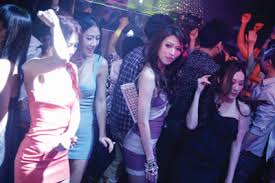
For those who don't know Lan Kwai Fong is Hong Kong's most notorious drinking area, a nightlife beacon for countless hip young things, synonymous with high style, good times and sex. Avowed playboy Steven (Taiwanese male model Z.O. a.k.a. Chen Zhi-Ming) cruises the bars and nightclubs almost every night with his friends, partying hard and scoring with as many hot women as he can. One night he meets gorgeous air hostess Jennifer (Cantopop star Shiga Lin) with whom he shares a night of passion. Yet their casual fling leaves Steven with a lingering feeling of true love. However repeated misunderstandings scupper their relationship and when, months later, Steven runs into Jennifer again he is dismayed to learn she is engaged to his boss, gregarious entrepreneur Leslie (Jun Kung Shek-Leung, with an amazing hairdo). Meanwhile Steven's pal Jacky (Jason Chan Pak-Yue) pursues Jennifer's foxy friend Jeana (Jeana Ho Pui-Yu) whilst trying to avoid his emotionally unstable and pregnant ex-girlfriend Mavis (Bonnie Sin Sik-Lai). Then there is nice guy lawyer Sean (Gregory Wong) who grows hopelessly infatuated with the alluring if remarkably promiscuous Cat (Dada Chan Ching) who bangs every guy she meets.
Wilson Chin's ode to Hong Kong's hedonistic hot-spot was a huge domestic hit spawning two sequels and an inevitable flood of imitators. Opening with an audacious Touch of Evil (1958) style tracking shot through lanes of leggy disco dollies, preening poser boys, inebriated foreigners, disco lights and pulsating techno music, the film certainly succeeds at immersing viewers in the beating heart of Hong Kong's vibrant nightlife. Undoubtedly a bid draw for audiences unable to sample the heady delights of Lan Kwai Fong themselves was the spectacle of an almost-ridiculously attractive cast of models, pop stars and young up-and-coming actors partaking in near wall-to-wall sex scenes. These managed to be crowd-pleasingly raunchy and even genuinely erotic remarkably without any nudity to trouble the mainland censor. Yet the film has more going for it than mere erotic spectacle.
Granted selling a seductive, glamorous image of Hong Kong as a hipster's paradise might be a substantial part of Chin's agenda. However, soundly rejecting old-fashioned, inflexible Chinese morality, Lan Kwai Fong paints an intriguingly empathetic, pleasingly non-judgemental portrait of the kind of fast-living, sex-obsessed nouveau riche youngsters most films find insufferably shallow. Less morality tale, more anthropological study the film scrutinizes an elite sub-strata of Hong Kong society through its dating mores, social codes and online interaction in a manner reminiscent of Jane Austen. Yes, that's right, Jane Austen. If Sex & the City basically updated Austen's social satire for the post-sexual revolution generation, as many cultural commentators have suggested, then the same applies to Lan Kwai Fong. For Austen's heroines marriage is more than a romantic fantasy. It is a necessity for any young woman looking to establish herself in the world. In Lan Kwai Fong the female characters prove far smarter and savvier than their skimpy designer fashions might suggest. Armed with a post-feminist outlook, on equal footing with men when it comes to sex (no one really exploits anyone here, save for the guy that pretends to be gay to seduce underage girls though he gets his comeuppance), they struggle to reconcile their practical inclinations ("Romance is nothing, money is practical" says one girl) with a yearning for old-fashioned romance. The key question driving the plot is whether a monogamous relationship can thrive or even worth pursuing in such a heady environment.
Adopting a scattershot narrative style somewhat in the vein of those saccharine ensemble rom-coms Garry Marshall has cranked out of late the admittedly loose plot moves literally from one party and sexual encounter after another, charting the shifts various relationships with a streak of sweetness that elevates things above shallow youth exploitation. Steven genuinely tries to stay true to Jennifer in the face of temptation while Jacky is not the self-centred playboy we initially peg him as, proving remarkably enough the film's moral centre and exhibiting considerable remorse over his treatment of Mavis. No matter how occasionally self-centred or mildly reprehensible these characters seem, Chin refuses to judge them. He accepts them as they are. Elsewhere Sean and Cat's unconventional romantic arc proves genuinely sweet as he slowly draws her from promiscuity into a loving relationship. In part the film is a story about growing up, going through the trials and tribulations of the dating scene but also its pleasures before emerging out the other side unscathed and more stable. While risqué by Chinese standards, Lan Kwai Fong ultimately upholds fairly traditional romantic ideals, complete with last minute dash for the girl with flashback montage scored by a treacly Cantopop ballad. Yet one could argue it is a stronger film for it.