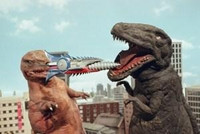
Seventy million years ago dinosaurs vanished from the Earth only to re-emerge from their underground lair in the year 2000 led by the evil Emperor Tyrannos (voiced by Mike Reynolds). Yes, the dinosaur can talk. Not only that but his glowing red eyeballs shoot energy beams able to turn ordinary placid dogs into snarling monsters! As Tyrannos and his dino army stomp Tokyo into dust the Japanese government summon D-group, a special squad consisting of cyborg siblings Zen (Dan Woren) and Ai (Robin Levenson), short and chubby Ippai (Joe Perry, not the guitarist from Aerosmith) and old and skinny Barra (Cam Clarke). With their hi-tech armoured tank named Izen One, able to split into a second flying vehicle called Izen Two, the heroes defend Tokyo from these and other monsters. And when their missiles have no effect on Tyrannus ("Nice try! Huh-huh-huh!"), Ai and Zen have another trick up their bionic sleeves.
Bad movie wags dubbed this "Attack of the Stupid Monsters." In any case it is not really a movie but a feature-length compilation of episodes from the Japanese tokusatsu television serial Dinosaur War Aizenborg. The original show was produced by Tsuburaya Productions the studio founded by Godzilla special effects chief Eiji Tsuburaya, creator of Ultraman (1967). It was their second show to adopt the unusual if eye-catching technique of combining live action hi-tech hardware and sets with animated characters following the 1976 serial Born Free, which had nothing to do with Joy Adams raising Elsa the lion. Max Fleischer achieved something similar with his groundbreaking cartoon Popeye the Sailor meets Sinbad the Sailor (1936). However Aizenborg had the added novelty of pitting anime characters against Godzilla-style rubber monsters that could breathe fire, somehow, and snarl cheesy dialogue like: "Humans are vermin! Attack! Kill! Destroy!" What monster-loving, anime-loving little Japanese kid could resist that killer combo?
In fact the compilation movie missed a trick by not including later episodes where Ai and Zen gain the ability to morph into a giant live-action Ultraman-style superhero, thus making the show even cooler for kids. Tsuburaya's follow-up series, also compiled into a feature film, Koseidon (1979) ditched animation but was otherwise even wilder combining time travel, evil alien invaders, a crimson clad superhero, heroic kids, a friendly dinosaur, a glamorous blonde fairy princess and epic battles fusing Star Wars (1977) with Jurassic Park (1993) into quite possibly the greatest TV show ever made. As things stood with Attack of the Monsters, Ai and Zen (as in Aizenborg, get it?) merely combine to form some kind of anime hermaphrodite space pilot, an idea even stranger than a talking dinosaur. The concept of the hermaphrodite super-being is actually a staple of Asian mythological fantasy, e.g. Swordsman II: Invincible Asia (1992) although the twins' primary weapon is their drill-headed spaceship which evokes Atragon (1963), the live action science fiction classic for which Tsuburaya directed the special effects. Whereas the monster costumes are not quite up to the standard set by the admittedly bigger budgeted Godzilla films, they are eye-catching and include nifty stop-motion and often beautiful miniature spaceships.
Given the film's origin as a thirty-nine episode television series the plot proves predictably episodic and incoherent. Additionally the American dub, which renames all the characters (Ai and Zen become Jem and Jim) sports even cheesier dialogue. When Emperor Tyrannos indulges yet another "death to all humans" rant, Barra wisecracks: "He sounds just like my mother-in-law!" Yet for all its inherent absurdities (even the President of Japan admits a talking dinosaur is hard to believe, although the scientific explanation for such proves even dumber) Attack of the Super Monsters conveys a certain apocalyptic horror almost like a juvenile version of all those revolt-of-nature movies from the Seventies. The opening scenes imply Emperor Tyrannos (called Dinosaur Satan Gottes in the original Japanese version) has risen to punish mankind for their abuse of nature, illustrated with a montage of animal cruelty. Hence he pelts Tokyo with giant bats “with a thirst for blood and destruction” out to destroy power plants across the city and infests the sewers with intelligent flesh-eating rats (shades of James Herbert!) led by a talking Stegosaurus (maybe not) that attack the central oil refinery. The heroes are notably kind to animals, going out of their way to avoid harming the Tyrannos-controlled creatures. That is with the odd exception of the rats whom they lure to their deaths in a huge bonfire. Maybe they just hate rats. In which case scrap my 'they're kind to animals' theory.