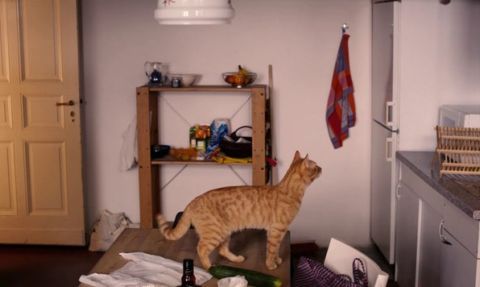
It is Saturday, and this German family are beginning the day where later on their relatives will be over for an evening meal, but in the meantime there is breakfast to be had. The mother (Jenny Schily) sees to it that the food is prepared, or at least the coffee and other drinks are, while the youngest child Clara (Mia Kasalo) performs her accustomed yelling, with her siblings still in bed and unmoved by events in the kitchen. They have two pets, a dog and a cat, and the cat is more engaged than the dog, who just barks randomly, yet the feline is taking an interest in his surroundings while hoping for something to eat as well. Meanwhile, a glass falls from the table and Clara cuts her finger on it, and mother relates a curious story of a cinema visit...
Well, it's obvious isn't it? The Strange Little Cat, or Das merkwürdige Kätzchen as it was known in its native land, was based on Franz Kafka's classic short story Metamorphosis, where a man wakes up in bed one morning to find he has turned into a beetle. OK, maybe it wasn't that obvious, but this is what director Ramon Zürcher said he was inspired by, and given how inscrutable the experience of watching it was, you would be moved to allow him his claims for a work that on the surface told the story of a very ordinary, urban, German Saturday in a family who were largely unremarkable, but insisted on hinting at mysterious undercurrents to the drama we watched unfold.
One supposed the Kafka connection was something to do with observing these people as if they were the subject of a nature documentary, only without a narration to inform the audience of what their motivations were. In its way it depicted the behaviour of the characters as little different from the behaviour of the animals we see, not only the cat and dog but sparrows and a moth as well, all subject to various whims, desires and whatever impulses guided them to act as they did, though even then there were activities that had you wondering why, as if no matter how closely you observed someone, there was always something they did eventually that you would not be capable of fathoming, simply because you were not in full possession of the facts.
So who knows why the mother feels the need to step lightly on the cat's head as it eats from its bowl, or later on why one of the sons appears about to step on it too - what is it about the moggy that has these two wishing to place a foot on it? There were more blatant mysteries than that, as seen by the bottle that when placed in a saucepan revolves on its base for no apparent reason, and doesn't bother anyone too much even though there is no scientific cause for it that we can perceive, it's just one of those little conundrums that are thrown up during the course of a day that don't trouble you too much since you have other things to think about and don't wish to spare the time pondering over every little enigma that arises between getting up and going to bed.
Nevertheless, there were recurring images and sounds that would have you trying to fit pieces together: what was the significance of oranges, and the way orange peel always lands with the white inside uppermost? Why does Clara insist on yelling? Why does the mother appear to be pressing down on a potential welter of aggression that only occasionally makes itself plain? If there is a rat outside a lot of the characters comment on, how come we never see it? And so on, though if Zürcher intended to show how even the most mundane circumstances were teeming with life, if not exactly vitality, then he may have been onto something as every five minutes someone new was introduced to the apartment that we hardly venture outside of, some more animated than others. More or less the impression you took away was that it didn't matter how everyday your existence was, there was something remarkable about how it was all brought about; the film didn't get cosmic or anything, and it was over very quickly, but maybe it didn't have much more to say than "Funny old world". Music by David Kesler.