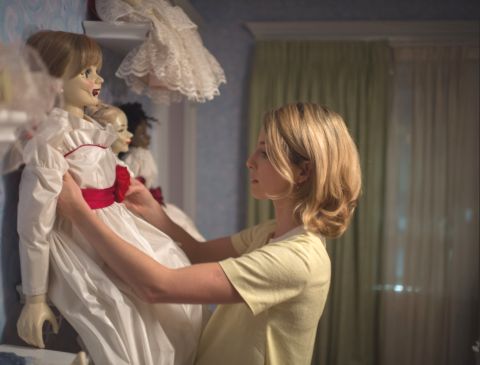
The year is 1969 and a young married couple, the Gordons, are looking forward to the birth of their first child. Father-to-be John (Ward Horton) works as a doctor while his wife Mia (Annabelle Wallis) stays in their new home in the Californian suburbs, though she warns him that he really should think about locking the front door when they go out, since the world isn't quite the safe place it was when they were growing up. They attend church and are friendly with their neighbours, a middle-aged pair who have recently seen their adult daughter run away from them to join some bizarre cult, and with the Manson Family murders in the news John and Mia do sympathise with the couple's worries for their offspring. But it is the couple who are in danger...
The Conjuring, while strictly top of the voice hokey in execution, did make a lot of money, featuring as it did a fictionalisation of the work of two actual paranormal investigators which had as part of its plot one case they took on concerning a supposedly haunted doll named Annabelle. Almost as if there was some devious plan behind these movies, no sooner had the dust settled on that shrill chiller than another one came along, and it was this, a prequel telling us what happened to make the doll possessed. That said, though the doll did exist, the story the filmmakers conjured (ahem) was all made up, so don't go fact-checking after watching it; you could tell that anyway, as the plot more or less ripped off Rosemary's Baby in a curiously reactionary manner.
That was a trend in these spooky horrors of the twenty-first century, to call back to a previous hit of yesteryear and build on those for their shocks and atmosphere, so if anything they represented a return to the sort of horror of the late sixties and early seventies where there were covens and cults everywhere you looked as the hippy craze passed into something both more down to earth and back to nature, and in fiction, more sinister thanks to the sensationally horrifying Manson murders which as mentioned are referenced in this. So you could regard the likes of, yes, The Conjuring and Insidious and Paranormal Activity even as a strong echo of what had been happening in the genre some forty years before, only stuff like Messiah of Evil or Deathmaster were not exactly blockbusters.
Perhaps it was a newfound superstition born of turning away from Christianity all over again being countered by a more forceful faith from the genuine believers that could explain this trend in the Western world, because quite often these efforts did pretty well for themselves at the box office, either that or it was a new audience unfamiliar with the material being copied that came to these movies with fresh eyes. If it was the former, that would explain the introduction of the Gordons as they thumb wrestle in the solemn surroundings of church, immediately marking them out as the Godless heathens who need a hefty dose of supernatural terror in their lives to shake them up and realise this God business is to be taken seriously.
Or this Devil business is, that was who such films were actually interested in, fear of the Almighty being apparently far less potent than fear of his opposite number. The Gordons have more than a brush with his works when that nice couple next door are murdered in their beds by Annabelle their daughter; she tries to kill them too only the cops see to it the woman is stopped in her tracks, a hail of bullets can do that. However, whoops, before she died she grabbed the porcelain doll and dripped a spot of blood on it, supposedly all that's necessary to possess it, though frankly the machinations of these evildoings were something of a mystery, almost as if the screenwriter was making up stuff off the top of his head. Before long, weird things are happening to the Gordons that look like an increasingly aggressive haunting (i.e. sound like an increasingly loud haunting), though disappointingly the doll didn't do much but sit on its arse for the duration, no slightly perceptible blinks or turns of the head. But then, these were so clichéd otherwise you could write them yourself. Music by Joseph Bishara.