Sea captain Thorne Sherman (James Best) is out on his boat with his second-in-command Rook (Judge Henry Dupree) with the purpose of delivering a batch of supplies to an isolated island off the coast, but they can tell there's a storm picking up that should arrive by the time they do, leaving any prospect of getting off the island delayed until the weather brightens. When they reach the pier, the place seems deserted but on further investigation the Professor, Craigis (Baruch Lumet), is there to meet them, though his companions appear uneasy for some reason, Farrell (Ken Curtis) carrying a loaded rifle and the boffin's daughter Ann (Ingrid Goude) looking anxious when Sherman announces there's no way off for now...
And why do they come across as so frightened? Our old enemy mad science, that why, oh, the Professor thinks he's doing the right thing in trying to solve the approaching problem of world overpopulation, but there has to be a better way than his methods! What he's done, with the assistance of his team, is create a way of making humanity half the size, thereby needing half the resources to continue life on the planet, only he has made the grave error of trying his genetic therapy on small mammals, and those shrews have grown to the size of wolves. As if that wasn't bad enough, they breed incredibly quickly, so the island is overrun with very hungry, poisonous and giant shrews!
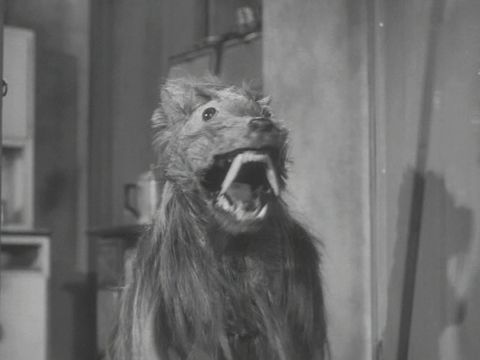
Or rather, a hand puppet and a bunch of dogs dressed up with long tails and masks to make them look more monstrous, though the puppet still looks like a puppet and there may be shrieking, squealing noises on the soundtrack, but you'd more expect there to be a chorus of jolly "Woof! Woof!" instead: basically, the filmmakers were fooling nobody. That was the reason The Killer Shrews garnered the poor reputation it did, with many lining up to make fun of it and its perceived issues, but wasn't there an element of snobbery to that? This was an independent production from Texas, one of the widest distributed of its kind, and was very extensively seen across the world, not just the United States. Its low budget was plain to see, but it was really no worse than many of its peers.
The science fiction and horror landscape of the nineteen-fifties (and not just that decade) was peppered with impoverished but ambitious movies doing their best to compete with the big boys, and sometimes they managed a respectable showing at the box office, it all depended on your gimmick. The Killer Shrews looked ahead to the siege genre of horror of which Night of the Living Dead was the prime example, and while nowhere near as good as that, you had the impression if they had ditched the whole massive shrew angle and just called it The Killer Dogs they might have been better thought of. Although not particularly great, this wasn't so bad either, and could be fairly diverting if you were of a mind to spend an hour in its ramshackle company.
James Best was the man carrying the melodrama, best known then for a string of Westerns and soon to be one of the most prolific television actors of his era, though it was as Sheriff Rosco P. Coltrane in The Dukes of Hazzard that he gained his lasting fame, a role far from his strapping hero here. There was undeniably some novelty in seeing a performer known for his comedy playing the straight man to a collection of mutts, but that was part of the (retrospective) fun, and he was probably the best in the cast which included a former Miss Sweden in Goude and Sidney Lumet's father as the Professor, though contemporary audiences would recognise producer/star Ken Curtis from popular TV series Gunsmoke. This diverse array of talents worked up some cheesy panic sequences, and if they fell back on the cliché of killing off the black guy early on (another, less welcome aspect that horror movies to come would embrace) then the way they get out of their chewy shelter was an innovative one. Of course, it was amusing to make jokes about this, but for what it was, it was fair. There was a sequel over fifty years later.