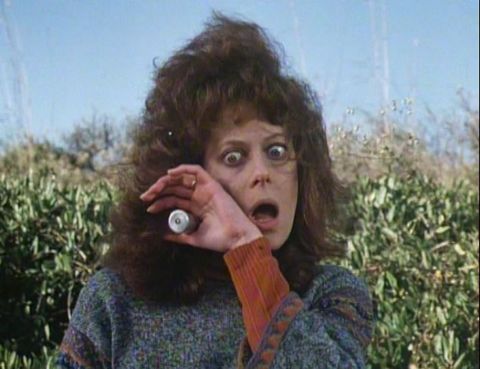
Artist Kay (Sarah Kendall) suffers terrible nightmares where she is being stalked by some sinister entity - she cannot work out whether it is a man or a monster, all she knows is that it lurks in the shadows and strikes when she least expects it. Her husband David (Alan McRae) seeks to reassure her that the fears of her bad dreams somehow bleeding into reality are entirely unfounded, what happens in her head while she's asleep will stay there, and announces that she could do with a break. To this end, he has arranged a holiday to an island off the south coast with Kay's brother Eric (Frederick Flynn) and his wife Brooke (Carol Kottenbrook), and they fly out in a light aircraft today...
What could possibly go wrong? If you're well aware that The Slayer was on the notorious list of so-called video nasties liable for prosecution if you were either selling them or even owning them in the Britain of the nineteen-eighties, then you'd have a good idea of what would happen to Kay and her chums, but was it really worth going to prison for watching back then? Of course not, watch it today and you'll likely be baffled that it was ever considered a menace to society since the 15 certificate shows far worse in horror movies than almost anything here, most of which took the form of the characters searching the island they were vacationing on for the individual who has disappeared, leading to a twist that will either have you groaning or musing over the mystery of what had happened.
Director and co-writer (with Bill Ewing) J.S. Cardone carved out his own niche of thrillers and horrors on a low budget with works such as this for some time afterwards, but thanks to the banning it was The Slayer that would remain his best known effort, an example of non-Hollywood independent filmmaking that took the exploitation route to make their profits, trying to beat the established studios at their own game by supplying cheap product that more or less operated as a delivery system for the thrills and spills the bigger businesses were aiming to provide. Movies like The Texas Chain Saw Massacre or Friday the 13th amply demonstrated you could be successful without a huge budget or big stars, and Cardone banked on that.
Not only Cardone, of course, as he was one of a number of enterprising folks thinking along the same lines. Unfortunately, as the slasher boom took hold on the moviegoers' consciousness those filmmakers often took the tenet "if in doubt, wander about" to heart therefore you would have a whole bunch of shockers that featured far too many padding scenes of its cast splitting up and scouting around, whether it be in a large building or the local forest - or the island landscape, as was the case here. It became such a cliché that it appeared to be included in every indie horror script (and not just the indies, the big boys were guilty of it too) intending that the gory shocks, when they arrived, would be more frightening as there was a long build-up to them, something horror directors decades later would emulate.
Not that it was any more palatable in the twenty-first century than it was back it the twentieth, but if we took the scenes that did not involve Kay and company creeping about, and they were in the majority, what were you left with? One benefit of a spooky location for the characters to explore would be the atmosphere that might generate, and The Slayer worked up a decent enough amount of that, so that the kills, when they finally showed up, had that particular timbre of dread that the horrors of this era counted on to grab an audience. The surprises here naturally were nothing of the sort, we are all too aware Kay is on to something when we see a fisherman beaten to death with an oar apropos of nothing other than alerting us to the villain on the island - we know nothing about him - but once one poor soul gets his head trapped in a pair of shutter doors, bloodily hanging him, it's plain somebody isn't messing about. As for the ban, only the death of a woman by pitchfork through the chest was an issue, but otherwise notable was The National Philharmonic performing Robert Folk's lush music.