Salomon Perel (Marco Hofschnieder) was born in April 1925 with the same birthday as Adolf Hitler, a man who would influence his life for the worse since Salomon was a German Jew staying in Peine just as the Nazi party was gaining power. One day he will always recall is when he was living with his beloved family, his father (Klaus Abramowsky) a shop owner, and the young man was in the bath when there was a riot outside as an anti-Semitic movement tore through the Jewish district. He was forced to escape from the house completely naked and hide in a barrel in the yard, and when he managed to return that night he found his family in mourning for his sister who had been murdered in the skirmish...
As if that wasn't bad enough, there are going to be further repercussions from the Nazis' grip on Europe, and personally for Salomon this means an incredible subterfuge must be undertaken if he means to survive. The theme of survival was crucial to most, if not all tales of the Jewish experience during World War II, and in few other places was it as deeply felt as in the life of Salomon Perel, for this was a true story of how he managed to pose as a Communist in Eastern Europe and a Hitler Youth Nazi in Germany without anybody suspecting he was neither. Interestingly, the reception in Germany to director Agnieszka Holland's film was rather cold, whereas in the rest of the world it proved to be the biggest success of her career, which gave some pause for thought.
This in spite of it being a German film (though French money contributed and Holland is Polish), so either Europa Europa was as farfetched as the local critics and audiences found it, or it struck a nerve they would rather not be struck. Whichever, while it was accurate to say Holland did not stick to the letter of Perel's autobiography, the spirit of the text was there, and it's not as if she embellished it with fantastical elements (the dream sequences were as far as she got in that area). A more pointed criticism would be that Salomon was a reactor instead of an actor at this stage in his own life, so the drama stemmed from watching him buffeted by events as if carried along by the current of history, adrift in a raging torrent and navigating as best he can.
Even so, that's more or less the way it happened, and if there was ever a male character whose penis was the most important part of his body outside of a porn movie it was Salomon here, as it both defines him thanks to its circumcised state, a symbol of his race, and could give him away at any moment, especially when Holland somewhat cruelly finds a wealth of reasons for her lead to be naked or in some other situation which leads the member to be revealed. Thus the hero's most obvious gender characteristic becomes synonymous with his religion, which can bring out a dark strain of humour in moments that must have been terrifying to live through, and perhaps illustrating that by keeping his head under enormous pressure, Salomon could have been more proactive than too many critics failed to give him credit for.
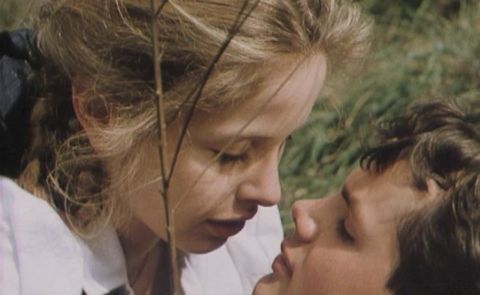
One thing a penis is used for, stop me if you know this, is procreation or some other sexual activity, and so again Holland emphasised her protagonist's dilemma by having characters who wanted to have sex with him pop up at regular intervals. At times this link with romance, or at least a healthy appetite for carnal pleasures, is a source of comedy, as when a homosexual soldier tries to seduce him and finds out his secret that way, making for a touching if unconsummated relationship that like so many of these vignettes ends in tragedy. Julie Delpy appeared for a while as Leni, the embodiment of the Aryan girl who looks beautiful on the outside yet whose mind is polluted by the Nazis; call her misguided, as Holland appears to feel sorry for her and the way her life is eventually ruined, though not as much sympathy the film feels for the Jews - at least Leni stays alive (we assume). It was significant that Europa Europa could have been played for farce, all the elements were there, yet the unease the lead feels never lifts, making for an absorbing if not quite fascinating film. Music by Zbigniew Preisner.