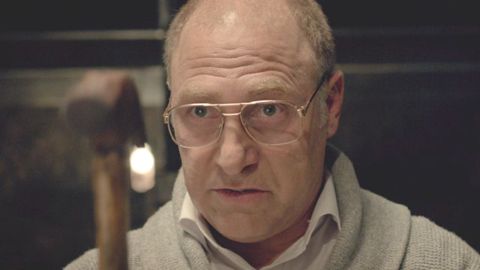
Micki (Lior Ashkenazi) is a cop who has his own methods of investigation, and when a little girl disappears in his region he goes to extreme lengths to find her. She vanished playing hide and seek with friends, apparently in an isolated area though there was one man seen nearby, and he is the closest thing Micki has to a suspect. Unfortunately, he just doesn't have any evidence to bring him in, so gets around that point by inviting a couple of heavies around to pick up the man, a schoolteacher named Dror (Rotem Keinan), and take him to an empty warehouse to rough him up in the hope he will spill the beans. They may administer a beating, but he won't confess anything, and to complicate matters an unseen kid has captured the scene on his cameraphone...
Big Bad Wolves was a curious beast, a thriller which appears to be heading into a morally cloudy state of affairs until it built to a twist in the last five minutes that merely confirmed what you expected any kind of twist crafted out of this material would be. It was a pity that writers and directors Aharon Keshales and Navot Papushado didn't have a good think about a more original method of wrapping things up, as the way they settled on was only a surprise if you thought the previous one hour and forty minutes had been deliberately leading you down the garden path and was instead heading for a denouement that would catch you off guard. As it was, it merely finished on a note that may have been downbeat, but was also plain to see from the first five minutes.
You find yourself thinking, ah, they're being clever here, they're setting up a plot designed to make the viewer question how far they'd be prepared to go for justice, and if torture is ever justified. You'd like to believe Keshales and Papushado didn't go along with that latter point, but here they apparently did, reasoning no matter how innocent you look you must be guilty of something, so deserve whatever terrible treatment awaits you, and if you are actually a criminal then so much the better. This reactionary streak would be offensive it it appeared they had considered what they were saying, yet more likely it came across as they wanted a twisty-turny narrative and would go for the big revelation at the end rather than something more thought-provoking.
It was a shame the whole affair became so redundant once it was over, since the creators demonstrated real talent in putting their film across, as genuine suspense was generated when Dror is kidnapped himself, by Gidi (Tzahi Grad), father of the missing girl, only most of her is not missing anymore since her headless body was found soon after Micki lost his position on the force thanks to the video. The cop has been staking out Dror's house, but it is Gidi who seizes the suspect after an altercation with Micki and ties him to an armchair in the cellar of a country dwelling where his screams will not be heard (Gidi knows this because he tested it with the oblivious estate agent). With Micki there too, the grieving father allows his upset to get the better of him and is soon breaking fingers.
Now, there was plenty of interest to say about human nature and the need to blame others for crimes you may be in a less than angelic position to judge them on, and for a while you can consider Keshales and Papushado were delving into the grim complexities of suspicion and revenge, but it doesn't wind up that way. Indeed, by the time it's over, it does feel very superficial and sadly all too similar to any number of banal television cop show episodes that litter the schedules; Quentin Tarantino named Big Bad Wolves as one of the best of its year, perhaps thanks to various resemblances to his own Reservoir Dogs, and it was true the injection of a bizarre black humour to the proceedings does energise it in a manner that simply churning out the torture sequences does not. You're not angry with this, but the more you think about it the less you appreciate being manipulated by it when you thought it was more clever than it is, and snags keep arising in the plotting the more you dwell on it. Not one to really muse over, then, it was all for effect. Music by Haim Frank Ilfman.