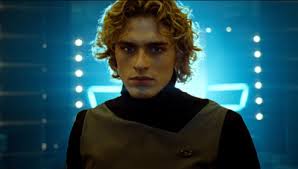
Part two of the most expensive science fiction film ever made in Russia opens with a quick recap of the story so far. After crash landing on an uncharted space colony called Saraksh, handsome hero Maxim (Vasily Stepanov), seemingly the most cheerful man in the galaxy, sets out to overthrow an evil regime called the Unknown Fathers who have enslaved the population using an invisible ray. These rays are projected from towers falsely sold to the public as a missile defense system. With his brainwashed, furiously protesting friend Gai (Pyotr Fyodorov) in tow, Maxim hijacks a tank and drives into the wastelands hoping to unite exiled mutant tribes against the military dictatorship. Yet the sad, pathetic, radiation-addled mutants are in no fit state to mount a resistance.
Conferring with the Wizard, a mutant child without a mouth but awesome paranormal abilities, Maxim learns of the Island Empire of ferocious desert warriors and borrows a rusty spaceship in the hope of persuading them to join his cause. But after numerous mishaps, Maxim and Gai find an abandoned submarine with a tank full of freakish mutant experiments and videos that show the Island Empire would make less than ideal allies. In desperation Maxim surrenders to the military in the hope he can overthrow the regime from the inside. He and Gai are soon press-ganged into a suicide attack against the Island Empire. Meanwhile, Maxim's lost love Rada (Yuliya Snigir) ends up imprisoned by the State Prosecutor (Fyodor Bondarchuk, who also directed the movie) as part of a fiendish, if obscure, plan to manipulate the hero for his own ends.
In adapting the acclaimed science fiction novel by Arkady and Boris Strugatsky actor turned director Fyodor Bondarchuk wound up facing exactly the same accusations that dogged his famous father, actor turned director Sergei Bondarchuk when he made War and Peace (1967) and Waterloo (1970) forty years ago. Many Russian critics derided Inhabited Island as a loud, flashy, spectacular yet ultimately empty bastardization of its far more cerebral source novel. Certainly aspects of the production suggest Bondarchuk set out to invest Russian SF cinema with a specific style of bombast and spectacle derived from Hollywood blockbuster merchants like Michael Bay, yet rather than bludgeon viewers into submission the rambling narrative gives some room for the ideas to breathe. The core conceit of an evil elite manipulating the public through brainwashing, propaganda, endless wars and good old fashioned fear-mongering can be interpreted as either an anti-communist or anti-capitalist allegory, though the finale paints this an explicitly Russian story when Maxim states that even faced with the problems of terrorism and poverty, he would still take freedom over oppression any day.
Bondarchuk throws in a rip-roaring car chase, tank battle and wire-fu fist fights but scatters them too wide across a sprawling story that constantly risks losing viewers through poorly clarified plot points. Everyone bellows their dialogue at the top of their lungs often punctuated with a bestial roar. The film has production value by the ton yet remains weirdly static. At its heart lies a promising ideological conflict between proponents of free will and the notion that left to their own devices mankind will bring about its own destruction. Yet for the greater part of the story Maxim is a pawn in the Machiavellian schemes of several villains, at least two of whom exit the story without so much as a face-off with the hero. Things happen but the plot goes round in circles, growing rather repetitive. Especially jarring is the bizarre twist that unmasks a hitherto minor villain as a major anti-hero who then kicks the shit out of Maxim whose own actions are revealed as misguided at best. Though the hunky, ever-smiling nicest guy in the universe fights his corner the conclusion implies he is willing to cooperate. Which is at once both refreshing and kind of a non-ending much as the closing quote: "You have to make good out of evil. There is nothing else to make it from" is both hopeful and really rather bleak philosophizing.