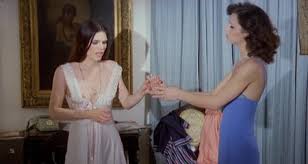
Some giallo villains wield a knife as a phallic weapon. The mystery murderer in La Sorella di Ursula (The Sister of Ursula) says to hell with such subtlety and opts for a killer dildo. With a sick gimmick like that plus a bevy of nubile naked victims the film probably doesn't need a plot to entice giallo fans, but concocts a wildly convoluted one anyway. Unstable Ursula (Barbara Magnolfi) and her sister Dagmar (Stefania D'Amario), who for some reason can't go five minutes without taking her clothes off, arrive at a beach-side resort hoping to recover from the recent death of their father in a tragic accident. Smarmy manager Roberto Delleri (Vanni Materassi) brings them along to watch a ridiculous nightclub performance from slutty singer Stella Shining (Yvonne Harlow) but Ursula immediately takes against one of the other guests, handsome junkie Filippo (Marc Porel). He draws some romantic interest from Dagmar but seems to be dating Stella. Except Stella is also sleeping with Roberto who, in spite of his own philandering, is less than happy to learn his wife Vanessa (Anna Zinneman) is enjoying a torrid lesbian affair with sexy Jenny (Antiniska Nemour). With so much sordid intrigue at play it is no wonder Ursula has psychic premonitions that something awful is going to happen. Sure enough a black gloved maniac targets loose women around the resort, shafting them to death with the aforementioned wooden dildo.
Remarkably this was not the only giallo released in 1978 wherein the killer's chief modus operandi was death by dildo. Red Rings of Fear, the concluding part of Massimo Dallamano's schoolgirls-in-peril trilogy, also features a deadly dong. You do not have to be a Freudian to discern the obvious subtext when each of the hitherto sexually confident female victims cower in fright at the sight of the enraged phallus. Nevertheless, the sex killings are more silly than disturbing or offensive. As a murder mystery The Sister of Ursula is frankly none too mysterious but writer-director Enzo Milioni pulls off the odd haunting frisson and the film is great fun for lovers of lurid camp. Like many gialli the film treads a fine line between erotic thriller and outright porn. It is not as genuinely sensual as Amuck! (1971) nor as unambiguously raunchy as Play Motel (1979) but Miloni allots more screen time to the explicit sex scenes and full-frontal nudity than the comparatively restrained bloodshed. Barely five minutes in, Stefania D'Amario strips off while Mimi Uva's delightful score goes into electro-funk overdrive. Viewers had better get used to Stella's theme song because they play it umpteen times, mostly during the sex scenes.
Ursula belongs to a tradition of giallo heroines who are sexually neurotic and prone to psychic premonitions of murder. Milioni repeatedly implies her simultaneous repulsion and fascination with sex is somehow symptomatic of a wider existential malaise in society. In one scene Ursula breaks down in an empty church and starts to rant how, having squandered civilization, all humanity has left is madness, sex and death. Certain aspects of the film's outlook coupled with the eerie location shots of centuries-old catacombs, churches, half-empty luxury hotels and beach houses come across like a seedy variation on an Alain Resnais film. Yet Milioni's film is too trashy to maintain a coherent ideology. The drama is as shrill as a daytime soap, a mess of tangled relationships, romantic frustrations and outrageous double-bluffs seemingly tailored to prove Ursula's theory that people are horrible.
Magnolfi, best known to Dario Argento fans for her scene-stealing turn in Suspiria (1977), and D'Amario hiss and spit at each other like a couple of alley cats for most of the film and none of the other characters are especially likeable either, even those eventually unmasked as heroic. Milioni is so intent on wrong-footing the viewer the behaviour of his characters strains all credibility. Still, there is an undeniable frisson when a bedroom door opens then closes by itself, implying Ursula's papa has fled the crime scene and the psychiatrist's rationale for her psychic powers must be heard to be believed. In real life Magnolfi was married to co-star Marc Porel who actually was grappling with a drug problem at the time that would sadly end his life five years later. Which makes the scene where he shoots heroin on-camera quite possibly the creepiest thing in the film.