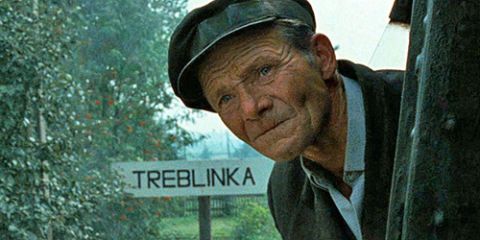
From before the Second World War even began, the Nazis had been plotting against the Jewish population of Europe, but once they were commencing their mission of invasion and conquest, that scheme had become yet more horrendous as they set up concentration camps in Eastern Europe with the purpose of exterminating an entire race. The documentary maker Claude Lanzmann sought to capture a verbal history of what had happened around forty years before, interviewing survivors of the camps, the guards who had put them to death, and the locals who had known about these atrocities but were apparently powerless to do anything to prevent them. All this would, the director was sure, create the definitive account of the Holocaust recounted by those who were there.
When you watch a war movie drawn from events in World War II, be it a contemporary classic like Casablanca, an action adventure such as Where Eagles Dare, or something more modern like Fury, the temptation to view them as simple goodies versus baddies yarns is strong, as if they were no more complicated than that. Yet what those "baddies" had in mind was something so vile that many of those fictions and works based in true stories choose not to remind you of what was at stake in too vivid terms, since reminding the audience of what the Nazis had schemed was so morally revolting that it would be difficult to enjoy the movie with that uppermost in the thoughts. A film like Shoah, whatever you thought about Lanzmann's methods, assuredly did not have that drawback.
If a drawback it was, as the Nazis were shown here to keep their death camps as secret as they could, so propaganda entertainments made at the time by the Allies could be forgiven for not depicting the full horror of what was actually occurring. Yet with each passing minute, Lanzmann's interviews brought up some fresh terror his subjects would detail, and detail was the word as the director pressed them on every small item of information, often to the point that you wished he would leave those who had suffered the most alone with their memories, whether they wanted to recollect them or otherwise. There's one polite gentleman who smiles when his talk begins, and when asked why he asks back if the director wishes him to cry - and then with Lanzmann's pressure, cry he does.
Of course it was important for these stories to be told, but the sheer length of the enterprise - around nine and a half hours - did mean it was possible to get the measure of the message by simply watching parts of it. An hour spent with a Jewish survivor alternating with a guard would be enough for most people, leaving only the hardiest viewer to sit through the whole thing. Shoah (meaning "Annihilation") was the equivalent of a doorstep of a book, but even then you wouldn't read that all in one go, leaving this less ideal for cinema and more for home video where you could watch what you wanted until you felt like a break. Not that the interviewees were not interesting, but Lanzmann cast his net too wide when more focus could have been more accessible; for many the vast running time was a good reason not to watch it, which was not the best state of affairs considering the topic.
If you did decide you could see it all, and indeed felt it was a duty of sorts to at least hear the stories of the death camp survivors, you would find much food for thought, by turns moving, sickening and anger-inducing. Lanzmann chose not to use any archive footage, which was brave and effective up to a point: we had listened enough to these tales of humiliation and indignity not to need to see the victims further exposed in those scenes many other documentaries used to illustrate the grim history. In their place were new shots where the sites of the camps were visited, some still standing as a monument and others entirely demolished out of shame; with the narration from the interviewees you were made very aware of just how overwhelming it was for the inmates back then, and take the guards' and other ex-Nazis' protestations (some captured with hidden cameras) with more than a pinch of salt. If there were many folks here you felt you needed to put an arm around and reassure, Lanzmann's rambling style was the main issue with sustaining the full duration. Important, but not the last word.