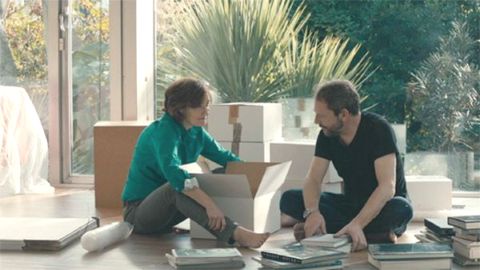
D (Viv Albertine) has been married to H (Liam Gillick) for some decades now, and for twenty years of that time they have stayed in a swanky Kensington town house which D is very attached to. She feels the most safe there, within the confines of those walls, and is reluctant to leave it even to walk down the street outside, she's a homebody and this is where she wants to stay. Unfortunately for her, her husband is growing increasingly keen to sell the place and move on to somewhere else, which although she would not come right out and admit it to him is a decision causing her no end of stress, and it's affecting her work as a performance artist which is gradually winding down to nothing...
Joanna Hogg's films as a director tended to split audiences down the middle, in fact not even down the middle as though there was a division, in the main most people who gave them a go found them tedious and were unwilling to meet them halfway which you really needed to do to get on with them. She was unwilling to make everything in the stories plain for all to see, so a certain degree of intuition and empathy was necessary to perceive what was between the lines, or more aptly between a collection of scene after scene of blandly captured domestic vignettes, in the case of this (her previous films to this had taken her characters on holiday). We could tell there was some unease in these sequences, but Hogg was not about to pore over every detail.
She left that to us, and when many audiences are not interested in doing half the work to get something out of their cinematic experiences, it was little wonder the reactions were so diverse: for every John Waters or Martin Scorsese (self-proclaimed fans of Hogg's efforts) there were many more to were going to dismiss this by using words and phrases like "pretentious" and "middle class" as pejoratives. While the characters were comfortable financially, simply because the film did not take a conventional approach to what could have been the subject for a television play that did not mean it was adopting airs and graces, if anything it stripped back anything such as that to get to the heart of a couple who do not spend all their time together pouring out their emotions.
Hogg liked to cast non-professionals, though did include the occasional proper actor, most notably Tom Hiddleston who in the period he had begun appearing in her films had become a bona fide star, so it was nice he still deigned to show up in Exhibition, even if it was just for a handful of short scenes as a smooth estate agent. Most of the time was taken up with D and H, and more specifically D; Gillick was an artist in real life as well as in the plot, making his acting debut, as was Albertine, best known as the guitarist with punk band The Slits although at the point this was released she had also published an excellent autobiography which featured chapters detailing her work in the movie which naturally brought more interest in it than might otherwise have been the case.
Improvisation from what amounted to a short story rather than a script was how Hogg went about making these, which offered a sense of authenticity when the characters were interacting, but since they were not much for exposition, it was possible to feel alienated from them as if they were not letting us into their lives as much as a more routine film would have done. That pressure of the audience's gaze, that expectation based on many other movies we had seen, if anything made the malaise D is suffering more acute, as if she can barely understand herself never mind us observing her every move, and Albertine's curiously unselfconscious performance, appropriate as most people are when alone as we see D much of the time, was undeniably affecting. We are not told plenty, but perhaps the biggest question is why there are no children in this relationship - has some secret sorrow kept the couple together? That final shot was telling, as if at last the house could feel like a home, which was rather cruel to D who at least seemed to be shaking off her domestic shackles by the close.