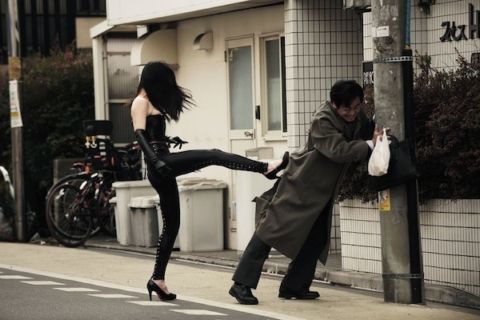
Takafumi Katayama (Nao Ômori) is an assistant at an expensive department store who spends his days inviting customers to make purchases; when he's not doing that he stays at home to look after his young son since his wife has been absent from their lives for a while now. But he feels he needs some excitement in his day to day existence, so what better way than to sign up with an exclusive domination club - the members being the ones who are dominated. For a fee he will be followed around for a year, with appointments for the preliminary period, by dominatrices who with his permission as agreed by mutual satisfaction in a contract will beat him up, often in public places. What could possibly go wrong?
Well, by the end of this it wasn't so much a question of that as it was more a question of what was possibly going on? This was comedian Hitoshi Matsumoto's fourth film as director, and showed no indication of letting up on his eccentricity nor his decidedly bizarre sense of humour. Not that you were aware this was a comedy from the beginning - unless you had read up about it first - and indeed the first hour is almost completely dramatic so that the laughs creep up on you. It could be the case you were chuckling before the organisation opts to visit its powerful wrath on the hapless Mr Katayama, but if you found yourself welcoming the downright weird twists in the final act then you would be beside yourself with mirth by the end.
A clue to Matsumoto's designs is in that title, it's not some code number, but an indication of who the movie is meant to be for: just as R15 is for those audiences over fifteen years of age and R18 a rating for the over eighteens, R100 tells us that this is solely suitable for viewers over one hundred, and the reason for that is shown in the brief scenes we witness between the production team. In a meta fashion, the story we are watching is the last work of the world's oldest film director (who is not Matsumoto, it should be pointed out), and he wanted it only seen by the incredibly elderly, the centenarians in fact, which leads to outright confusion among those who had to make the film with him. As one of them points out, how many over hundreds visit the cinema anyway?
Back at the main plot, Mr Katayama appears to be representing a side of the modern Japanese character who wishes to be punished in some manner, even for something they haven't done. Whether that means being tied up and whipped in the privacy of their own home by a professional or being subjected to public humiliation was a conundrum R100 seemed constantly on the verge of answering, but eventually you would have to twig the director wasn't entirely interested in that and was more intent on either baffling the audience or making them roar with delight. In effect, the former would be more likely than the latter, but Matsumoto certainly has his fans around the world, and watching a film that pretty much operated as a long preamble to an absurdist punchline would float many a boat.
Nao Ômori would be best known internationally for his excursion into Takashi Miike land as the title character of Ichi the Killer, but in this case he was essaying more of an everyman, just an everyman whose barely admitted desires led him to awkward encounters with the denizens of the S&M club (named simply "Bondage"), every one of which give him a well nigh spiritual euphoria symbolised by his eyes turning funny and a ripple effect of concentric circles emanating from his beatific expression. The trouble is, he cannot rely on this lack of control in his life to be anything but an agent of overwhelming chaos, as seen for instance when he visits his comatose wife in hospital and one dominatrix shows up and binds him in front of the bed his oblivious spouse lies in, then proceeds to beat him - still, he cannot resist that eventual ecstasy. Suggesting that the individual examples of pleasure specific to ourselves make us slaves to their pursuit as well as absolutely ridiculous in the process, R100 was undeniably amusing: wait till you see the CEO! Music by Shûichi Sakamoto and Shûichirô Toki.