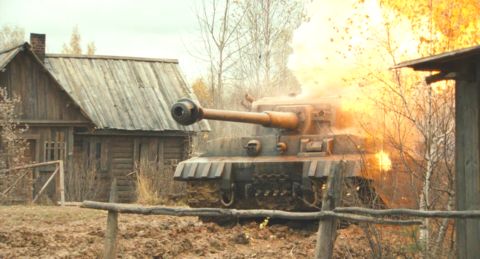
The Second World War is drawing to a close, and at the Russian Front, which is advancing towards Berlin with increasing speed, a tank commander (Aleksey Vertkov) has been found in the ruins of his vehicle on a battleground recently vacated by Hungarian forces which took their toll on the Russians. This unidentified man had suffered ninety percent burns and appears to be on the brink of death, but he is fighting back against his wounds and is taken to the hospital to see if anything can be done, though the doctors and nurses are sceptical. Nevertheless, after a few days the nameless soldier has miraculously recovered to almost full strength, and he wishes to get back to the action, for he can talk to tanks...
He doesn't stand there next to the tanks having a heated conversation with them, but he claims to have a psychic bond, just one element of White Tiger that made it not your average war movie. Director Karen Shakhnazarov helped adapt Ilya Boyashov's novel to the screen, but even a short description of the results as a World War II action flick with a dose of the mystical did not exactly do it justice, as it had too much on its plate to really do justice to in an hour and three quarters, though that did not stop Shakhnazarov doing his damnedest to have his ambitions realised on the big screen. Many liked the two main tank warfare sequences to the exclusion of the philosophical aspects which dominated increasingly the further the film drew on, but you couldn't have one without the other.
Not according to this, at any rate, as it builds not to a climactic scene of explosive violence, but a quiet justification of Adolf Hitler as he explains himself to what is presumably intended to be the Devil incarnate. Justification? Wouldn't that indicate the film's message had gone seriously off the rails somewhere? So you would think, but the ending acts also as an explanation of why there would be a ghostly "White Tiger" tank popping up at unfortunate times to blast the Russians' ones to Kingdom Come, and also why it appears in possession of supernatural powers. It doesn't fly or shoot laser beams, but it does, as it is claimed by those who are able to catch sight of it and live to tell the tale, exist as an invincible entity, unmanned and operating under its own animating spirit.
What does that have to do with Hitler excusing himself, or indeed the filmmakers' explanation for their invention of the spooky Nazi tank, a living vehicle? This is where it grows murky, as when it gets down to it, the story informs us that all this may have happened and it may not, but we have no way of proving one way or the other since all proof is reliant on memory, and memories cannot be trusted absolutely. Which could be backing some wooly thinking, after all it takes more than word of mouth to bolster a report, especially as the years wear on just about everything is recorded to almost take the place of needing to recall things when they are captured on photographs, videos and the like, and there was plenty of recording going on in the Second World War as well.
This could lend White Tiger an inscrutable cast, leaving us deliberately unsure of what to trust, not simply a case of watching the action setpieces - which are very fine - then dismissing the mumbo-jumbo as that latter is what takes up most of the second half. As the mystery tank commander, pressed into service to stop the killer Nazi tank, Vertkov is nobody's idea of a heroic he-man but he does exude a certain enigma that renders him a curiously religious figure, sort of a Van Helsing to an automated Count Dracula. The other lead was Vitaliy Kischenko as Fedotov, essentially the audience's surrogate as he tries to make sense of what is unfolding just as we are; it's a very decent performance that grounds what keeps threatening to get very silly indeed in a sincere grasping towards some kind of truth about mankind's diabolical need to blow up and murder those they do not necessarily agree with. Yet mix all that in with a heavily postmodern take on war, and you were more likely to be following Fedotov into confusion than revelation. Music by Yuriy Poteenko and Konstantin Shevelyov.