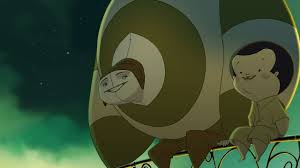
As night falls troubled orphan Tim (voiced by Lloyd F. Booth Shankley) can't sleep without gazing at the star his late mother promised would always watch over him. But when Tim sneaks out from his bedroom at the orphanage onto the roof he discovers his special star has vanished from the sky! The shock almost knocks him off the building, but he is unexpectedly rescued by an army of cats led by the magical Cat Shepherd (Robert Paterson). It so happens cats are responsible for ensuring all children get a good night's sleep and the irritable Cat Shepherd can't understand why Tim is not tucked up in bed. In return for Tim promising he will go to sleep, Cat Shepherd spirits him to the realm of Nocturna where magical beings arrange events of the night. In charge is the mysterious Mocha who gives short shrift to Tim's questions about the ongoing disappearance of stars and other lights around town. So Tim tricks Cat Shepherd into aiding his investigation and together they find that the light-snatcher is a giant sinister shadowy fiend rampaging through the city. But who is responsible for unleashing this monster?
Perhaps the most remarkable thing about Nocturna is how such a beautifully animated, wondrously dreamlike and strange children's film remains all but unknown? Made in Spain this artfully offbeat fantasy is at once both deeply idiosyncratic and oddly timeless, evoking the flights of fancy detailed in Windsor McKay's seminal and hugely influential comic strip Little Nemo in Slumberland (itself adapted for the screen as the flawed but endearing anime Little Nemo (1992) and bizarre live action effort Dream One - Nemo (1984) starring Harvey Keitel!) as filtered through the aesthetic of Tim Burton. Those spiral clouds and corkscrew hairdos on various characters are decidedly Burtonesque. With its preoccupation with night terrors and dream realms the plot also shares similarities with the writing of comic book guru and occasional children's scribe Neil Gaiman.
As with some of Gaiman's work the story grows a little esoteric in parts. Where most mainstream children's cartoons take time to establish the rules of their specific fantasy world this dives headlong into surreal whimsy. Yet it is grounded by a level of psychological realism exploring the idea that children create their own monsters. If the viewer is willing to go along for the ride they will find this a most magical and rewarding journey. As one often finds with classic children's literature the journey through the other realm becomes a rite of passage for the child hero who learns his actions, or in this instance more importantly his attitude, can affect his environment. While Cat Shepherd thinks the night is nothing less than wondrous, he is aghast to discover Tim is afraid of the dark. He needs to be near the light of his guiding star. On a psychological level the story told in Nocturna is more complex than it initially appears. Tim learning to overcome his fear of the dark becomes a clever metaphor for coping with loss.
The English dub opts for an offbeat mix of British and American voice actors that somehow sounds oddly appropriate. It is foremost a visually driven film however and the handsome two-dimensional animation is nothing short of stunning, rich in characterization worthy of Disney at their best. In its charming ability to humanize a mystical world of fairies, monsters and magical beings as a factory-like environment full of quirky, quarrelsome personalities the film shares some things in common with similarly richly detailed mythology of Studio Ghibli's Spirited Away (2001). Co-directors Adrià Garcia and Victor Maldonado take time out to sketch endearing little vignettes involving imps that write and read aloud people's dreams while they sleep (and bemoan their own work!), an orchestra of cuddly creatures performing a mini-symphony of night music (the sounds we hear after dark), feisty little guys called Luminouses who live inside street lamps and chatty hair stylists that specialize in giving girls that unique "bed head" look.