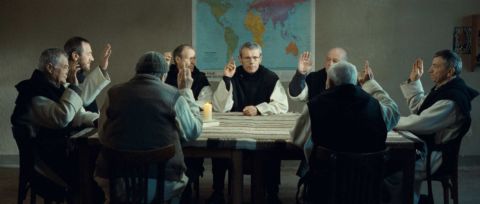
Algeria in the mid-nineteen-nineties, where political turmoil has been overtaken by religious turmoil as the country grows more dangerous thanks to Islamist groups attempting to enforce their beliefs and rules on the population through use of violence, executing innocent people they regard as having failed to respect the Islamists' very strict view of their tenets. In the middle of all this is a Catholic monastery headed by Brother Christian (Lambert Wilson) who tends to not simply his fellow monks, but the locals as well, seeing to it that these folks are looked after whether that be clothing them or treating their medical ailments. This community is proof that citizens of different beliefs can live in harmony...
So naturally, and tragically, they become a target for the least tolerant in society who not only wish to prove their way of peaceful coexistence is wrong, but exploit that for their own ends. Of Gods and Men was based on real events, yet another example of religion twisted to excuse an atrocity - if you did not know how this turned out in life, you could certainly guess thanks to the feeling of impending doom director Xavier Beauvois concocted around his characters, keen to do justice to the actual figures as much as he was intent on crafting a compelling story. That latter was more difficult than you might have expected, as much of the film took the form of quiet conversations and muted emotions.
By the conclusion you will be aware that this downplaying of the heartrending situation until the final ten minutes was an artistic choice, and one which paid off with the near-climactic sequence where the monks sit around the meal table and listen to a Tchaikovsky piece - Swan Lake - undimmed in its charge in spite of it seeming the most obvious way of pushing the audience's buttons imaginable. Some were resistant to such manipulation, but for many more this scene was one of the most moving they had seen as the dreadful circumstances finally sink in and the holy men twig they are emulating Christ's journey to the crucifixion, though their redemption is far less of a given in a work that questioned, however subtly, the wisdom of its characters.
The main question the monks must ask themselves was summed up by the old Clash song, oddly enough, "Should I Stay or Should I Go?", and it's one they keep returning to. For the atheist, the answer seems obvious, get the hell out of there before you are murdered by the terrorists who are encroaching on their existence and ruining the stability the Christians forged with the Muslim neighbours. On the other hand, being Trappists they believe they have a solemn duty to the locals they have looked after for so long, and recognise these poor people would be far worse off if they were forced to leave, their poverty only exacerbated by the fact there would be no charity in the area for which their quality of life would be far less than if the monks were not there.
This was in no way a thriller, therefore there was a lack of suspense to scenes of the monks discussing amongst themselves what they should do, and their conclusion was controversial, seemingly putting themselves in harm's way for the sake of principle rather than common sense. But when your whole life revolves around the story of self-sacrifice for the greater good, it's not too surprising what they decide, though again how this made anything better was debatable other than increasing the outside world's contempt for the Islamists, along with having the Algerians sympathetic to the ways of peace lament that it had come to this, their friends and family were in peril for what many saw as a bastardisation of religion that, as with Christianity, did not set out to be warped into a weapon for men of violence. This was, as you can imagine, weighty stuff, though the sad-eyed view of an issue Beauvois made little moves to solve did have its own fatalistic humour should you try to find it; you couldn't help but be depressed that the world had been brought to this, however.