Jim (Roy Abramsohn) has been taking a family holiday in the Disneyland theme park in Florida but on the morning of the last day he receives a call on his phone from his boss, just as he has gotten up out of bed. Standing on the hotel room's balcony he is informed that he is fired, but is reluctant to tell his wife Emily (Elena Schuber) so as not to spoil the vacation, planning to break the news later, but oh how it preys on his mind. It's as if the whole world is mocking him, from his two children - his son locks the balcony doors, trapping him outside - to the theme park itself, but as his experiences grow ever more hallucinatory he begins to doubt his sanity. Is it the spirit of Disney crushing him or the realisation that his midlife crisis is finally upon him?
Or maybe both? It may surprise you to know this, but just as there are legions of folks around the (small) world who love Disney and all their media entertainments, there is a small but forceful minority who actively detest the House of Mouse and all it stands for. You can imagine it was for those naysayers that Escape from Tomorrow was made, and the fact it was originally called Escape from Tomorrowland, as in the attraction, until Disney demanded it be changed could give you an idea of how powerful the company's lawyers can be. The funny thing was (peculiar, not ha-ha) they didn't demand the whole movie be withdrawn, for it had a very unusual production history.
Basically director and writer Randy Moore was a guerilla filmmaker, fair enough with everyone and their granny making videos of their lives there was little unique about that, except Moore crafted his feature by illegally using both Disneyland and Disney World as a location, a big no-no for anyone but the parent company itself. He took his small cast and crew and planned their scenes like a military operation, making sure not to be caught by the park's security, and once all the footage was captured it was back to the editing room to add the special effects, conjuring up a horror/science fiction hybrid with an extremely novel setting. From watching it, assuming you knew nothing about it beforehand, you would assume Moore hated Disney and wanted to take them down a peg or two, but there were other options.
Such as the observation that Disneyland would be fine if it were not for all those holidaymakers hanging around, making huge queues for the rides and behaving obnoxiously: Jim has his run-ins with the tourists as he endeavours to make this last day at the resort memorable to make up for the disappointment the family are about to face the next day when he has to admit he has no income anymore. Yet the Disney urban myths seem to have taken over his mind, those weird stories that will tell you yes, there are rich businessmen prepared to pay huge sums to use the performers who play the Princesses as prostitutes, as long as they wear the costumes, or the large turkey legs sold as fast food are actually roasted emu legs, none of which are true in real life but in the hazy environment of the movie, drained of the colour Disney prides itself on, you can see why Jim would succumb.
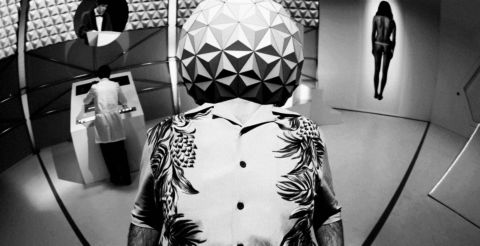
There are more than the myths to contend with, as he appears to fall victim to some condition known as cat flu (what else would strike terror into the heart of Mickey Mouse?) so suffers visions of the robot figures on the rides turning demonic thanks to simple yet effective CGI. Then there's the fear of seeing the opportunities of his youth slipping away with increasing alacrity, embodied by the personas of two young French women who torment him though not on any purpose on their part; that said, even Jim's son notices he is making a point of following them around the rides, leading to a trip on Space Mountain (offscreen) that ends with the kid throwing up. The Epcot Center plays its part too, that part being a sci-fi conspiracy not unlike Westworld where some sinister technological plot is hatched, though like the other weird details this is dropped when Moore impatiently skips to his next setpiece. This wasn't slick (the green screen was obvious occasionally), but it was original, and you had to admire their cheek in even slightly corrupting such an obsessively wholesome institution. Music by Abel Korzeniowski.