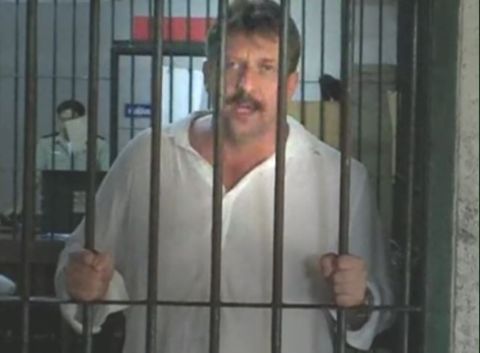
In Thailand during 2008, the American security services congratulated themselves over an arrest they had orchestrated: the notorious Russian arms dealer Viktor Bout had been caught in their sting operation and was now in a Thai jail awaiting extradition. But he protested his innocence, and many voices were raised questioning precisely how guilty he was, reasoning that while he had transported weaponry on his network of cargo aeroplanes, he was really just the middle man and not the one either pulling the triggers or making the guns in the first place. In fact, in some quarters Bout was regarded as a scapegoat to make it look as if the United States was acting to end terrorism, when in fact their efforts were purely cosmetic...
Russian documentary director Maxim Pozdorovkin followed up his acclaimed film about the incendiary punk band Pussy Riot with another subject close to the hearts of his fellow countrymen, teaming up with American producer Tony Gerber to create this profile on, as the title states, one of the most infamous Russians of his era, and asked whether he was as dangerous as the United States government would have us believe or whether he was simply a go-between shouldering the blame for an industry of death and destruction that made so much profit that governments of all stripes were reluctant to regulate it to any meaningful degree.
As the card before the credits informs us, the arms industry makes enough bullets to kill everyone in the world twice over every year, so somebody is making a hell of a lot of money out of this, and one of those people used to be Mr Bout (pronounced "Boot") until, as this film illustrates through animation and as it happened insights from wife Alla Bout, his eventual trial saw him locked up for the minimum sentence, which was twenty-five years. Naturally, this is something of an impediment to the directors getting an interview, but they got around that by having correspondence between them read out by an actor (Gennadi Vengerov) where the inmate was able to put across his side of things, not it must be said in an especially illuminating fashion.
Better were the interviews they did manage to secure with people who know Bout and those who have reported on his tale, though even then the picture they painted of him leaned on the contradictory. The American agents would have us believe this was a very dangerous man who has supplied arms to African rebels then graduated to placing the guns and bombs in the hands of international terrorists who are planning to bring down the West and any authority sympathetic to democracy, and it's true these insurgents have to get their arsenal from somewhere, weaponry not being the kind of thing they could make themselves. What the inquiry here was concerned with was if Bout was the supplier.
Fortunately for the makers, he had a love of recording his life on video camera, and once he emerged as a businessman in post-Soviet Russia, seizing the opportunities as his homeland were desperate for imported goods now poverty had them in its grip, he bought himself the trappings of wealth which included those cameras. Many gaps in the narrative are plugged by footage of Bout's family get togethers, his business parties, and his meetings with various shady folks to keep those planes flying: it wasn't only instruments of war he carried from one place to another, he was forever seeking a market and moving product to where it was needed. One of the interviewees calls him a "fool" who didn't really have a grasp of what he was doing and how far in over his head he was - he certainly doesn't come across much like the fictionalised version of his character in the Nicolas Cage movie Lord of War, then again you have to ask if he was so naive, how come he made so much from his businesses? What was clear was the enormity of the gains made from death and destruction.
[Kaleidoscope's Region 2 DVD has deleted scenes and a trailer as extras.]