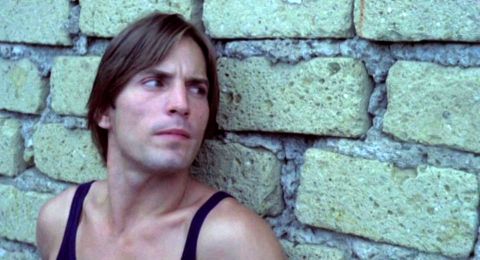
Joe Brezzi (Joe Dallesandro) eases himself down a rope hanging from a prison wall, a jail he has been incarcerated in for a while but is now escaping from with some success. He gives the guards the slip and races across the fields until he happens across a farmhouse where a worker is unloading crates of produce from the back of his car. Sensing an opportunity, Joe picks up a nearby rock and creeps up on the poor man, braining him with the large, blunt object and leaving him unconscious on the ground. But just as he is about to steal the car, another worker appears and launches himself at Joe with a pitchfork; the felon negotiates this impediment and knocks this guy out with the same rock. Now he has transport...
But where is the villain going? He has a plan in mind, unlike so many others of the strain of Italian crime thrillers this belonged to where a criminal, usually more than one in fact, would break into a house owned by a bourgeois bunch and proceed to terrorise them for the rest of the movie. Inspired by the likes of Sam Peckinpah's Straw Dogs and Wes Craven's Last House on the Left, these were thrillers that relished the humiliation visited upon the rich by the poor, subversively lauding the evildoers because they were in effect getting one over on the privileged, and so it was here, though Madness was a significantly pared down variation on a formula that was morally dubious at best.
For all their claims to addressing the class system, these efforts were just as much about titillation, maybe even more so, and in this case that was largely provided by one of the female stars, Lorraine De Selle who offered a committed performance as the sister-in-law Paola more often than not playing her scenes stark raving naked. Joe finds her and her sister Liliana (Patrizia Behn) and the husband Sergio (Gianni Macchia) in their rural holiday home which he breaks into, has a look about, then spends the rest of the day and night spying on them from a crack in the window shutters. Doesn't he have anything better to do, like getting away? Ah, but you see he has something stashed underneath the concrete fireplace, and he needs to take an opportunity to grab a pickaxe and set about smashing it up.
If you're a fan of both digging and naked women, then Madness, or Vacanze per un massacro if you spoke Italian, was the ideal movie for you, combining repetitive scenes of characters hacking away at that hearth with shots of De Selle in a state of undress, and Behn too to a lesser extent. Surprisingly, Dallesandro didn't get naked at all, often his willingness to do so was the reason he was cast, but here the breeks resolutely stayed on; this was one of the movies he made in Italy to capitalise on his fame in Europe, returning to America a short time after, but making an impression on Continental filmgoers as not exactly a great thespian, but one who was willing to take risks such as regular sex scenes. Indeed, there are stretches of this where director Fernando Di Leo seems more intent on crafting a softcore experience.
Di Leo made his name in the seventies as a major player in the Italian crime movie sphere, a plethora were made in that decade to reflect the perilous state of the nation's society when it seemed criminals of various stripes were running riot in the land. Audiences could not get enough of seeing the fictional variety in their cinemas, as if those dire newspaper headlines had given them a taste for the material, which may seem a curious reaction, but you could argue the filmmakers were merely reflecting reality with something not that much more heightened than the real thing. Di Leo was considered one of the most accomplished proponents of the style, but he was winding down by the stage he made Madness, and it shows, running through tired themes and sequences in professional but disinterested fashion, leading up to an ending the Italian title gave away before you'd even seen the film. Notable for unfolding under posters of Marlon Brando and John Travolta, this was pretty basic stuff, complete with Paola's dodgy post-rape characterisation as loose and manipulative. Music by Luis Bacalov.




 Display comments