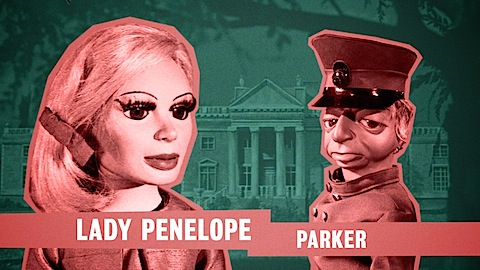
On Tracy Island, a secret location in the middle of the ocean, Lady Penelope (voiced by Sylvia Anderson) is visiting but the Tracy family have left for the day, leaving the place in the charge of her butler and chauffeur Parker (David Graham). She walks in on him reading a book and inquires what it is about, whereupon Parker gets all existential on her, asking his boss what she thinks the meaning of life is. The reason for this query is because the book is a history of Supermarionation, the puppeteering process which producer Gerry Anderson and his team used to bring to life some classic children's television shows of the fifties and sixties, and which happened to include a certain series called Thunderbirds...
The legacy of Gerry Anderson is one which echoes down the decades, largely because he was so prolific, a true workaholic who never considered retiring and was able to produce a variety of mostly science fiction action series and the occasional movie in his near-fifty years at the head of his companies. Much as with Doctor Who, the kids who grew up with Anderson's puppet and then live action shows felt great affection for them as they appeared in their lives at a formative stage and never underestimate the power of a great entertainment that can be looked back on with such warm nostalgia as the likes of Thunderbirds could. Since they were repeated regularly, they have been part of millions of childhoods.
And continue to be, not only because those programmes are so widely available and often stand the test of time thanks to the sheer weight of imagination they provided, but because of what they prompted as well. In these days where the model work in special effects has fallen by the wayside to be replaced by computer graphics (as indeed Anderson gave in to with his return to Captain Scarlet in the twenty-first century), never underestimate the value of watching meticulously crafted miniatures flying around the screen - and more often than not, blowing up in an explosion too. Which is a roundabout way of saying this documentary had the feeling of both a tribute and a last chance to catch up with the talents who had brought the Anderson efforts to life.
It was made by Stephen La Rivière and Andrew T. Smith, who had experience in the field of making DVD extras, which is why Filmed in Supermarionation came across as one of those special features expanded to movie length; it did play in cinemas, but the project was better suited to an evening in front of the television, as after all its subject was. Also, a whopping two hours to ensure it packs every puppet show of the first couple of decades of the Anderson endeavour meant it could be better appreciated in segments rather than in one go, for there was a lot of information crammed in which could overload the viewer's memory banks if they were not careful. A mixture of archive interviews with the deceased and new interviews with the hardy survivors, with many a colourful anecdote, only contributed to the overstuffed mood.
Yet if you were a diehard fan of Andersonia, what better path to take than to watch all the nuggets of info in one place, as delivered here? Obviously Thunderbirds is given the most coverage as their biggest success, and they capture just what the appeal was with loads of well chosen clips (the editing is superb) and a running commentary from Parker, Penelope and occasionally the boffin Brains, with diversions to the two movies which flopped (though nobody explains why the second was made after the first failed). The second division is well covered too, Stingray and Captain Scarlet bookending the International Rescue series, but they went back to the beginning as well with the Andersons' first ever work (a cereal commercial starring Noddy) and their black and white efforts, though they did not go past the end of the sixties after the much-underrated Secret Service. Along the way resident geniuses Barry Gray (who composed the music) and Derek Meddings (special effects) are given their due, but it's Gerry, with all his admitted misgivings, we never forget to thank. This is the next best thing to a book on the subject.