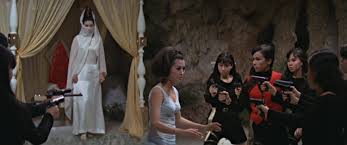
Hong Kong is caught in a crime wave orchestrated by a masked mistress of disguise known only as the Temptress of a Thousand Faces (Lau Leung-Wa). Her ingenious escapades amass a fortune in stolen jewels while the police are unable to find her hi-tech underground lair staffed by an army of scantily-clad nymphets. Nevertheless, sexy police detective Ji Ying (Tina Chin Fei) vows she will bring her to justice. Unfortunately this boast earns Ji Ying the enmity of the Temptress who kidnaps her as part of a particularly fiendish plan.
While there were no shortage of male super-spy wannabies on the international stage following the international success of James Bond, the so-called "Jane Bond" cycle was a phenomenon unique to Hong Kong cinema in the Sixties when female stars ruled the roost. The Shaw Brothers studio produced a slew of stylized spy thrillers featuring their most popular actresses including Cheng Pei-Pei in Operation Lipstick (1968), Lily Ho Li in Angel with the Iron Fists (1966) among several others, and Jeanette Lin Tsui in The Golden Buddha (1966). But it was the amazing Temptress of a Thousand Faces that went on to amass a substantial cult following in the west following a belated home video release in 2004. Production-wise the film is the epitome of Sixties chic with space-age décor, psychedelic sets (check out the Temptress' quasi-futuristic lair), groovy surf rock soundtrack composed by Wang Fu Ling, and super sexy outfits for the female cast. But its pleasures lie beyond the surface delights of a Sixties spy thriller-cum-superhero movie. What modern viewers found most impressive was that Temptress of a Thousand Faces casually subverts traditional gender roles in superhero movies.
Here it is heroine Ji Ying who is the two-fisted crime fighter, solving clues, evading deadly death-traps and battling armed mobs single-handed (albeit scantily-clad) while her boyfriend Yuk Dat (Chan Leung) essays the role of plucky reporter with a nose for trouble. In fact women inhabit all the really significant roles here. Their actions drive the plot forward, they handle most of the action and initiate all the sexual activity. By contrast the male characters are either subservient or inept, although Yuk Dat eventually proves his worth. The film reflects the state of female-led Mandarin language cinema at that time which was exactly what directors like Chang Cheh and uber macho stars like Bruce Lee were rebelling against when they made movies like One-Armed Swordsman (1967) and The Big Boss (1971). In assessing the Jane Bond genre, most cult film fans commonly site James Bond movies, Batman (1966) and some of Mario Bava's works as likely inspirations but it is worth pointing out the genre had its roots in early heroic swordswoman films. It was influential Cantonese filmmaker Chu Yuan who truly crystalized the genre with his trend-setting The Black Rose (1965) and its sequel The Spy with My Face (1966) which sired a sub-genre of remakes, pastiches and parodies that endure to this day.
Unlike the serial-like structures of most superhero films around this time, Temptress of a Thousand Faces attempts a more ambitious, dare one say Hitchcockian plot. Posing as Ji Ying with the aid of a seemingly limitless selection of rubber masks, the titular villainess frames the dishy detective for jewel theft. Sure enough, neither Ji Ying's cop colleagues nor her idiot boyfriend believe her protestations of innocence. After guiding a greasy guard's hand along her silky thighs so she can slip out of handcuffs and grab his gun, she goes on the run hoping to foil the Temptress' attempts to wreck her reputation. Director Cheng Chang-Ho ensures the film moves at a furious pace with an explosion or shoot-out or kung fu fight every few minutes but invests as much energy and excitement into the steamy love scenes (at one point Ji Ying literally fucks Yuk Dat back to his senses!) and cabaret dance numbers (including less than subtle close-ups on the beautiful dancer) as he does to the spectacular stunt work (Ji Ying's escape down the side of a skyscraper proves a highlight). The Korean born filmmaker was one of the key figures in the development of Asian cinema, not least because he made King Boxer (1970) a.k.a. Five Fingers of Death at Shaw's, the first Hong Kong made martial arts movie to play theatres in America. Active in movies and widely lauded in his native country since 1951, Chang-Ho signed with Shaw Brothers in 1968 where his first film was Temptress with a Thousand Faces. One of his later films was noteworthy Heads for Sale (1970), a period martial arts adventure that also features a strong female lead driving a complex plot. In 1973 Chang-Ho left Shaw Brothers for rival studio Golden Harvest where he made The Skyhawk (1974), a comeback vehicle for veteran kung fu star Kwan Tak-Hing (the original Wong Fei Hung) and Broken Oath (1977) an epic starring Angela Mao, the most popular female action star of the Seventies. Towards the late Seventies he returned to Korea where he continued directing although the films remain more obscure.
Wisely, Chang-Ho does not pitch Temptress... into self-conscious campiness a la the Adam West Batman movie although the film has plenty of humour. Much of it centres around the exploits of a couple of klutzy cops played by Fan Mei-Sheng and Fan Dan who spend their time peeping through a keyhole at sexy showgirls when the ought to be safeguarding the jewels. However, the sequence wherein Ji Ying escapes the Temptress' hi-tech hideout battling ninjas clad only in her underwear only to emerge before a street jammed with motorists honking their horns at her proves equally amusing. As does the outrageous twist wherein Yuk Dat dons drag as part of a wildly implausible scheme to prove Ji Ying's innocence. For the most part though the film is wholly sincere in its intent to thrill and amaze and yokes a degree of suspense out of the mystery over the villainess' identity which is not as clear-cut as you might think.
This was the last film for actress Lau Leung-Wa. Despite a career stretching back to the early Fifties she remains best known today for her work behind the scenes in conjunction with her first husband, controversial director Lo Wei. She served as a costume designer and production manager on many of Lo's films and was personally responsible for convincing Bruce Lee to sign with Golden Harvest. After her divorce from Lo she quietly faded from the spotlight but was fondly remembered by no less a star than Jackie Chan in his autobiography "My Story" where he recalls her as a great advocate and calming influence on her belligerent husband.
However, the real star attraction in Temptress of a Thousand Faces is the lovely Tina Chin Fei. Following her scene-stealing supporting role in Shaw Brothers' beloved musical melodrama Hong Kong Nocturne (1966), Fei's chic sense of style meant she took to fanciful spy capers like a duck to water. She played the villain in Angel with the Iron Fists and another resourceful heroine in Lo Wei's excellent Summons To Death (1967) but for fans, Temptress of a Thousand Faces remains her finest hour. Fei essentially delivers not one but two performances since she is not only tough, sexy and charismatic as Ji Ying but also plays her vivacious adversary in disguise. She also wears the best outfits giving an abject lesson in how to kick ass while looking great in an array of psychedelic patterned mod mini-dresses. The flimsy little pink floral number with matching earrings she wears whilst seducing Yuk Dat is my personal favourite. Yowza. Tina Chin Fei segued from spy films to sex comedies in the Seventies after which her appearances on the big screen grew more sporadic before she rounded off her career as host of her own television show The World of Tina Chin Fei.