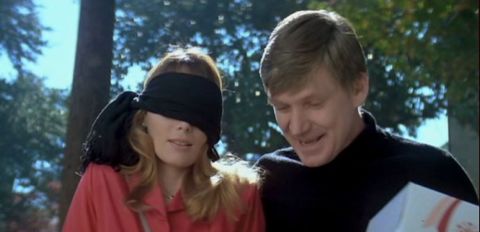
Julia Sullivan (Trish Everly) works as a tutor at a school for deaf children where she is much respected, but she has a dark secret in her past which she has managed to suppress until now. It wasn't anything she did, it was what was done to her, as she is a twin and when they were younger her sister Mary (Allison Biggers) would torture her both psychologically and physically, acts which Julia hopes she managed to get over now she is an adult. However, all that trauma is about to come flooding back when she received word that Mary is now seriously ill so she feels duty bound to visit her at the hospital where her uncle, Father James (Dennis Robertson) breaks the bad news that Mary's mind and body have been deformed by a strange virus...
One thing everyone who has heard of Madhouse knows is the fact of its inclusion on the British banned films list known colloquially as the Video Nasties, which as with all too many of the movies on that document lent it a reputation it perhaps did not deserve. It was certainly a violent experience in places, but director Ovidio G. Assonitis was evidently aiming for atmosphere rather than a succession of intense gore sequences, so while bloody moments punctuated the plot, a lot more of the running time was devoted to creeping about, on the part of the victims as well as the villains. Thanks to that, many gorehounds have found Madhouse something of a disappointment.
That said, if you adjusted to the steady pace of the film and appreciated what Assonitis was trying to do, you might find it more rewarding as if nothing else it was the best-looking horror movie he made, with a very early eighties gleam to the photography, especially in the moodily shot nighttime scenes. He was best known for his liberal borrowings from bigger hits - he didn't helm that many films, but most point to works such as Jaws rip-off Tentacles as evidence that he was a hack, pure and simple. Yet with this you could perceive a genuine talent, maybe not so much in the scripting but more in the assembly of visuals which filled the wide screen fairly pleasingly, not bad for a film where the close proximity to danger in cramped places was often the key.
As for that plot, it was American and Italian slasher movies Assonitis was influenced by this time, though just as he replaced a giant shark with a giant octopus before, instead of a butcher's knife the weapon of choice for the baddie was a trained Rottweiler which when unleashed would go straight for the jugular - the necks of Julia's closest friends, that was. As the regular updates in caption form regarding how far we were away from the heroine's birthday indicates, it was the campy slasher Happy Birthday To Me which this owed a debt to, especially given they each built up to a birthday party from Hell as their finale, with dead bodies as guests, but as that was no classic in itself, you could forgive Assonitis for playing out a variation on that plotline when much of this enjoyed a neat line in an oppressive, off-kilter mood.
Unusually in this brand of horror, there was even a period of mourning for at least one of the characters, though in light of what kind of character he was it showed at least a little respect to the sensibilities of the audience, even if more sensitivity wouldn't have bumped him off at all. That a now utterly insane Mary appears to have escaped from hospital to murder people with her big, black dog would be enough premise for many slashers to be satisfied with, but there's a major twist to this which you might be able to see coming (infamously the original video case gave the game away through its spoilerific front cover). Anything to keep this interesting, one supposes, and it is to a point as Julia (Everly never made another film after this, her sole screen outing) recruits her coterie of companions to help her through her upsets only to put them right in the firing line, hanging around in her in need of renovation townhouse and suspecting she may not be alone. It was what happened to the dog which put many off, but Madhouse was quirky enough to divert. Music by Riz Ortolani.
Aka: There Was a Little Girl; And When She Was Bad