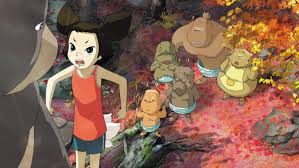
One hundred years ago an alien spacecraft crash-landed on a forest mountain in South Korea right in front of Yobi (voiced by Son Ye Jin), a young five-tailed fox spirit who lost her family to hunters. Since then Yobi has looked after the rambunctious furry little Yoyo aliens, hiding them away from human beings. Unfortunately the Yoyo's latest attempt to jump-start their spaceship results in a calamitous crash caused by the youngest alien, the aptly-named Naughty. Scolded by his elders, Naughty runs away but is captured by curious kids at a summer camp for "maladjusted" children. Using her shape-shifting powers Yobi adopts the guise of both a sexy single mom and an energetic little girl to enroll herself in the camp where she ends up falling in love with a friendly little boy called Geum-ee (Gong Hyun Jin).
Throughout the past decade the Korean film industry all but eclipsed Hong Kong as Asia's foremost producers of glossy action fare, comedies and special effects blockbusters but their efforts to outdo Japan in the field of animation drew a more muted response. For decades Japan utilized the talents of Korean animators yet for some reason when local artists set out to craft their own movies they repeatedly failed to produce the kind of international hits comparable with Akira (1988), Doraemon (1979) or the output of Studio Ghibli. Lee Sung-gang looked set to buck that trend when his feature debut, My Beautiful Girl Mari (2002) won a slew of awards around the world that led some to label him the next Hayao Miyazaki. Which predictably proved the kiss of death as Sung-gang's second feature, Yobi, the Five Tailed Fox received a severe drubbing from critics and animation fans alike and sadly sent the bruised filmmaker scurrying back to the realm of animated shorts.
Yobi is not a bad film by any stretch of the imagination. In fact parts of it are downright inspired, laden with a sense of wonder and moments of audacious visual invention liable to delight any sci-fi-fantasy mad child (or grownup) along with a streak of lyrical melancholy you just don't find in animation outside Asia anymore. Yet at the same time it is easy to see why so many people found the film so frustrating. Inspired by the Korean legend "Gumiho" the film mixes traditional folk tales with science fiction in a rather awkward and ill-conceived fashion. Frankly, as adorable as the Yoyo aliens are there is no reason for them to be included in this story. Sure enough once Geum-ee enters the plot, Sung-gang casts the Yoyos aside before they eventually exit the plot in strangely casual fashion with scant regard for their seemingly close emotional bond with the titular heroine. There is a strong history of wild genre mash-ups in Asian cinema, whether in live action productions like the Hong Kong made A Chinese Tall Story (2005) or Japanese The Sword of Alexander (2007) and too many anime movies to mention. Unlike those examples Sung-gang takes too long to establish a solid emotional core to string all his cool concepts together.
Scripted by acclaimed live action director Lee Chang Dong, the film reworks the original legend about a fox spirit attempting to steal the soul of a man by turning the creature from antagonist to sympathetic protagonist. In that area the film succeeds although Yobi, the aliens and the supporting cast of animals (the giant bear mourning the loss of its cub is especially engaging) and otherworldly beings prove more endearing than the various child characters peppered throughout the narrative. Aspiring stand-up comedian Geum-ee is amiable enough, albeit a trifle bland, but Sung-gang makes a bold choice in portraying the other youngsters as bratty, rude or abrasive. It is an admirably non-sugar-coated depiction of childhood yet the director never really grapples with the issues plaguing these "problem children" or detail the rather dodgy concept of corralling kids in a camp where an unsympathetic coach tries to bully them out of their insecurities.
As often happens in these sorts of stories Yobi finds herself pursued by a grumpy old ghost hunter who has a grudge against fox spirits. She also finds an ambiguous ally in a slouch-hatted, two-dimensional spirit called Detective Shadow. He claims he can help Yobi become a human being but first she has to steal a human soul. Sang-gang's debt to Hayao Miyazaki and his Ghibli cohort Isao Takahata grows increasingly obvious as imagery and plot elements evoke Spirited Away (2001) and Pom Poko (1994) but the third act descent into a surreal apocalyptic nightmare proves genuinely spectacular and suspenseful and the melancholy resolution does attain some semblance of their lyricism. Provided you can overlook a few conceptual flaws this is good-natured, exuberant fun.