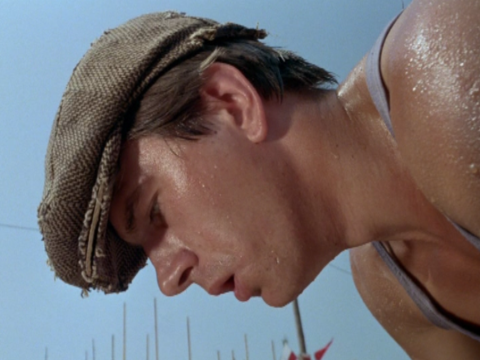
Agnieszka (Krystyna Janda) is a film student who must complete a documentary to finish her studies, and she thinks she has the ideal candidate, though persuading her tutor has become a problem. Nevertheless, after a heated discussion she gets her way, as she often tends to do so headstrong is she, and now can begin assembling her footage, a mixture of vintage newsreels and new clips she and her two-man crew have shot themselves. And the subject? A former hero of Poland who saw his crown toppled and is now never mentioned: Agnieszka believes this to be fascinating, and so sets about gathering the news footage and first, heads off to a museum where there is a marble statue of Mateusz Birkut (Jerzy Radziwilowicz) hidden away in storage...
Well, she has to start somewhere, so where better than the formerly very public face of the hero who meant so much to so many, then was cruelly knocked off his pedestal by the ever-shifting rules and regulations of Communist-era Poland, and not all of them stated outright leaving us sad but unsurprised that Birkut should have fallen from grace so badly. This was made by director Andrzej Wajda, the most famous Polish filmmaker to have actually stayed in Poland when so many of his contemporaries fled, not that he would toe the party line which is what makes works such as Man of Marble and indeed its sequel, Man of Iron, such fertile ground for those wishing to understand what the cultural climate was like in that land.
Some express surprise Wajda was able to get away with something as critical as this when the authorities were so conservative and prone to censoring anything which dared to speak out against the totalitarian regime that at this point was about to be challenged by Solidarity, the political movement that did so much to bring democracy to Poland in the following decade. But of course, the filmmaker was not going to get away with anything like as much as he would have wanted, which is why many viewers get to the end of what has been a marathon near-three hours of movie only to find it didn't have a proper ending. Or rather it did, but Wajda was forced to remove it by the censors, though that did spur him on to craft the sequel in 1981 which just about wrapped things up.
Back at Man of Marble, or Czlowiek z marmuru to give it the original title, employed here was a technique that many observers compared to the structure Orson Welles popularised (to a point) in Citizen Kane, as Agnieszka interviews various people who knew Birkut to piece together what precisely happened to him since the records run out after he was disgraced. With a mixture of face to face documentary techniques and surreptitiously captured footage, she forges ahead with her project, and a lot of the reason this did not drag in spite of its length was down to leading lady Janda who here is a force of nature, depicted by Wajda in a curiously upfront fashion, patently the young, vital stand-in for himself; he used wide angle lenses to exaggerate Janda's body language and had her almost agitatedly go about her work, chainsmoking and taking nobody's no for an answer.
So the Agniezska business was entertaining as well as educational, showing how anyone who wanted to set the cat among the pigeons had their work cut out for them, which Wajda would have been all too aware of, but did it really match up with the flashbacks, was the real issue? Certainly the iniquities visited upon Birkut were enough to sustain our interest, as he emerges from the record-breaking success as a bricklayer of arranging for he and his team to lay thirty-thousand bricks as part of a new town endeavour in mere hours, with a crowd gathered, radio commentary and an oompah band ensuring the spectacle, almost a parody of the kind of thing pro-workers Communist achievements would be proud of. But when his newfound status as a hero gives him a more lucid view of the problems in Poland, his livelihood is sabotaged and the film almost turns into a conspiracy thriller, though one without a solution. It remained two plots edited together rather than a smooth combination, but was more engaging than many political films. Music by Andrzej Korzynski (seriously groovy).