It is two hours after the raid on an Indonesian tower block which has seen many police and even more gangsters wiped out, and the man who was responsible for the success of the operation is now back at the station pondering whether it was a Pyrrhic victory as only he and another, badly injured cop survived, though they did manage to bring in the man who was on his boss's hitlist. So when said boss proceeds to shoot the criminal right beside Rama (Iko Uwais) he is shocked - what was the point in bringing him in alive in the first place? Not that he has much time to consider this, as he is told he has a new mission to undertake: go undercover with the most successful mob in the capital, via the local prison.
Well, that should be easy-peasy in light of what happened in the first Raid movie, an example of a little flick with an almost childishly simple idea of what a martial arts effort should be - goodie moves up each level of a building beating baddies - that went on to win a worldwide audience outside of its home Indonesian crowd. That was down to two reasons, largely, one was expat director Gareth Evans who had a very clear idea of what he wanted in his work, pretty much thanks to him not being able to make his epic straight away and opting to craft a smaller scale effort to drum up interest in it. The other was his leading man, Iko Uwais, an unassuming personality onscreen who transformed into a human dynamo the second he was called upon to arms.
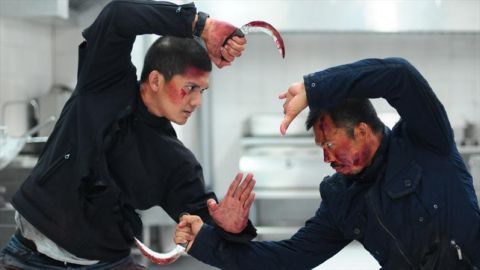
And legs. And more or less anything he could use to beat his way out of trouble, which in the Raid sequel was very useful indeed when it settled into a pattern of scenes designed to forward the plot, often tense exchanges, and outright, expertly choreographed violence, the product of Uwais's skill and his ability to have his fighters behave precisely as instructed for he was the man doing the combat choreography. It wasn't all hand to hand thrashings, as Evans mixed it up this time with some more traditional action, the main setpiece being a car chase which involved some ingenuity to get across the kineticism he desired. That occurred in the last act of the movie, as did the fight he and his star were most proud of where Rama has to battle an assassin (Cecep Arif Rahman) armed with small scythes.
Those setpieces were well worth waiting for to a point, though whether they were worth waiting over two hours for was another matter. As if energised by their success, Evans and company's efforts lasted a good two and a half hours, as if, like Christopher Nolan was for his blockbuster The Dark Knight Rises, they had remembered watching Sidney Lumet's police corruption epic of the eighties Prince of the City and noted that with no half measures they could expand on their themes and action as far as they could hope to hold an audience's attention. Of course, for some fans they would happily have watched three and a half hours of The Raid 2, they were so impressed, and the production quickly took on legendary status as one of the least compromising martial arts movies ever made.
But that wasn't quite true, as it was not without problems. One problem in particular, and that was Rama; there was absolutely nothing amiss with Uwais's fighting, it was why we were watching after all, but his character didn't do very much that was actually heroic until his cover is blown very late on in the story and he finally commences kicking bottoms and many other body parts with righteous fury. Before that, there really should have been more tension in the drama as Rama remained far too passive for too long, partly because Evans was generous enough to offer roles to others who then demonstrated their talent with silat (the Indonesian martial art), which gave excellent show off sequences for the likes of the tragically wronged Koso (Yayan Ruhian was back) or the hitpersons Hammer Girl (Julie Estelle) and Baseball Bat Man (Very Tri Yulisman) - guess how they get their nicknames - but sidelined the conscience of the picture (Rama). Many aficionados wouldn't be bothered as long as heads were cracked, but it suggested more honing was necessary outside of the action excellence.