Guilt-ridden Gulf War veteran John Norton (Rusty Joiner) moves into a quiet little farmhouse in a remote part of the American West. All John wants is to be left in peace but instead he finds himself ambushed, twice, by trespassers from another dimension. First by Aleya (Masiela Lusha), a plucky Elf princess seeking her mystical wizard guardian, then by an army of honest-to-goodness Orcs hot on her trail. After seeing the latter off with a pump-actions shotgun, an injured John is nursed back to health by blind Native American mystic Whitefeather (Wesley John). From Whitefeather, John learns that not only does his new home hold an ancient gateway to a magical realm but he has somehow inherited the mantle of its wizardly guardian. And then some more bloodthirsty orcs turn up.
In the early Seventies low-budget horror movies became the first to address issues arising from the Vietnam war paving the way for mainstream Hollywood to finally confront those themes towards the tail end of the decade into the Eighties. As a cheap and cheerful direct-to-video production from the fine folks at the Sci-Fi Channel and Arrowstorm Entertainment, Orc Wars is too comic book corny to adequately explore Iraq War anxieties the way films like Deathdream (1974) dealt with the earlier conflict but boasts an interesting layer of subtext. Eccentrically monickered leading man Rusty Joiner essays an intriguingly haunted yet affable action hero who laments the blood on his hands and so doubts his worthiness as mystical protector of a fantasy realm. Of course that does not stop him from blasting Orcs to bloody pieces pretty much right from the moment the slimy green uglies arrive at his door. If there is one thing that separates a twenty-first century exploitation film from a Seventies one it is that contemporary low-budget movies might raise similar issues but rarely develop them. Which is a shame.
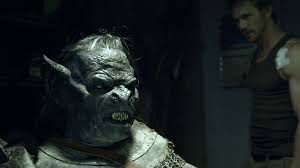
You can look at Orc Wars as either a belated cash-in on The Lord of the Rings: The Fellowship of the Ring (2001) or a hasty coat-tail ride on The Hobbit (2012) but the fact is the plot, co-authored by director Kohl Glass and writer Jason Faller, draws as much from old westerns and Eighties horror favourites like House (1982) and The Evil Dead (1983) as it does from Peter Jackson's epic Tolkien adaptation. Needless to say it is nowhere near the calibre of those efforts, though it's slightly more entertaining than House at any rate. Despite its DTV pedigree the film is attractively photographed with ambitious, occasionally eye-catching visuals including a fairly accomplished CGI dragon, and nice production design. The orc makeup is not up to much but the white veiled wraith-like spectral villainess makes a vivid impression.
Aside from the impressively muscled Rusty Joiner the film features a pleasingly gutsy turn from sitcom star Masiele Lusha, formerly of The George Lopez Show, as wide-eyed Elf princess Aleya. Regular viewers of DTV horror will likely also welcome an appearance from the ever cute and perky Clare Niederpruem, one of the more redeeming features of Zombie Hunter (2013), as a luckless but resolutely upbeat estate agent who figures in some of the funnier gags. Isaac C. Singleton Jr is similarly memorable as the growling Orc that stubbornly refuses to die. With the exception of the all-action third act, Orc Wars tends to plod when it should charge along with exploitation energy, but features a pleasingly nuanced back-story and some offbeat ideas. Glass stages decent action sequences that switch between gunplay and swordplay as Aleya proves no slouch with a blade and Whitefeather does a brief riff on Zatoichi. The gore is slapdash and the jokes dumb but kind of endearing if you are in the right mood. If you really want to see Orcs blown apart by automatic weapons this is definitely the movie for you.




 Display comments