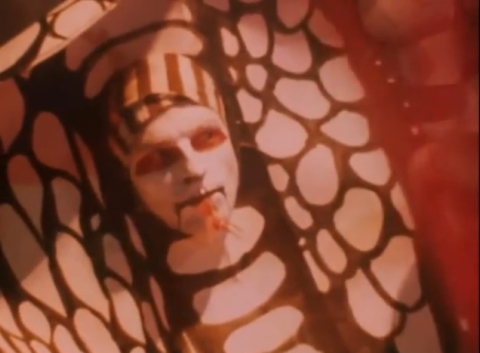
Out in a rural area near a forest, a group of people have assembled to perform a sacred ritual, which involves the gradual burying of The Majoon Traveler (Ira Cohen) in the mud and earth that one of the party has dug up using a spade. While music is played and dances occur, he is finally completely covered, whereupon he is reborn, emerging from the dirt to take his place among the revellers, his naked body still caked in the earth, as the ceremony continues and the Traveler is eventually escorted to a different gathering altogether...
Or at least that's what looks like is happening, but as with a lot of experimental films the phrase "your guess is as good as mine" continually threatens to surface in the mind of the viewer, the viewer who does not have specialist knowledge of precisely what the creators had as regards to their ultimate goals. In this case the driving force behind the phantasmogoria was a counterculture staple for a good few decades, Ira Cohen, who was instrumental in bringing the more way out works of his contemporaries to the audience who might best appreciate it, in his capacity as a publisher and writer himself.
Knowing he was author of The Hashish Cookbook back in the nineteen-sixties might well tell you all you needed to know about the desired effect of this half hour short, and indeed conditions to experience The Invasion of the Thunderbolt Pagoda under, and today the work remains something of a relic of those heady times, one which basically looks like a bunch of dressed up hippies having a fine old time which may or may not translate to the audience. Actually, what it most looks like is Flaming Creatures, which is no surprise because the Jack Smith-directed underground cause célèbre was a great influence on Cohen who numbered Smith among his friends and allies: the man himself purportedly appears here as well.
So if you could envisage a less sexually explicit version of that earlier effort you might have a better idea of what the aims were, though by this point Kenneth Anger was making a splash on the art film scene as well, arguably far further in fact, and there's more than a hint of his arcane mythmaking here too. Essentially what you got was a barely explained series of usually distorted images very much reminiscent of his mylar photography (which Cohen was probably best known for artistically), capturing a selection of his mates all dressed to the nines in various colourful costumes and painted with outlandish makeup, generally lounging around and throwing shapes, though unlike the Smith reference point there was little of that work's overt fetishistic imagery.
Not sexually fetishistic at any rate, though it takes all sorts, and when one presumed high priestess holds the cone she has been putting on her head over her crotch then there's little doubt of what she was indicating, yet also the playful, free-spirited aspect to the film. Along the way you can spot the likes of a green Mr Spock from Star Trek, either that or he's supposed to be some variety of elf, and a myriad of faces appearing from the confused patterns mixing across the screen, including one with what resembles a snake's forked tongue twitching from between his lips. Something that does come across is that everyone is having a great time with their mystical games, although that's not always what translates into those watching at the remove of decades will appreciate, even with the assistance of mind-altering substances, but as a curio, with its atonal drone on the sountrack and succession of lightly cosmic visuals, it can be more evocative of an era and place, for this lot at least, than many a facsimile.