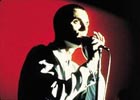
David Byrne walks onto the empty stage with his collar buttoned up and a guitar in one hand, a cassette player in the other. He tells the audience he has something to play for them, starts the cassette, then launches into Psycho Killer, one of the best known songs by his band Talking Heads; that's just his voice, his guitar and the drum machine recorded on the tape. As the song comes to an end, he begins jerkily dancing across the stage and the crew wheel on the amps for Tina Weymouth's bass, and the two of them start another song...
The greatest concert movie ever made? That depends on whether you like Talking Heads or not, but they certainly won over plenty of converts with Stop Making Sense, a document of their tour which was directed by cult filmmaker Jonathan Demme. The band and their director were obviously in synchronisation with what they wanted, that essential quality of the group's image which was at once accessible due to their tunes, but also at a remove because of their inscrutable nature, as if they were in on a joke that they would take too long to explain, so it was better you simply enjoyed the performance for what it was and leave the thinking to them.
This happened along around the point where the great concert movies had wound down from their heyday in the late sixties and seventies; some still have a lot of affection for Woodstock and Monterey Pop, and if you're in a grimmer frame of mind Gimme Shelter would take the crown as the most riveting concert film, though that was not exactly down to the music. Even fans of Led Zeppelin would tell you The Song Remains the Same left something to be desired, and Let It Be was only half a concert, the rest being rather more uncomfortable for The Beatles' ardent followers. By the punk era, compilation flicks of various performances looked to be the way forward, but then video began to take hold.
So Stop Making Sense could have easily have been released straight to video, except that the band and Demme expressly made this with a cinema audience in mind. Not that it was flashy, full of clever effects and the like, but it did put you in the middle of the crowd at the concert so you had a pretty good idea of how that experience would play out. By the twenty-first century the concert movie had made a comeback for 3D extravaganzas from such artistes as U2, Justin Bieber and Katy Perry, but even they could mark their achievements, whatever you thought of them, as a progression from the event that Demme created with this. The barrage of songs presented here represented the band at their highest level, and as if they knew it they put their everything into the final result, which paid dividends in the entertainment stakes.
Surprisingly, there wasn't that much decoration or business going on around the band itself, but what there was came across as perfectly in keeping with their aesthetic, with screens projected with random words on them, Byrne's "big suit" which he donned for the second half, and innovative lighting techniques sustaining things visually but never distracting from the sound. There's not much between song chatter, just the odd, deadpan comment from Byrne such as "Thanks! Does anyone have any questions?", though he certainly threw himself around the stage, even doing circuits of it at one instrumental break. It wasn't all about Byrne, of course, as the other members of the band got to perform their half time tune Genius of Love from the offshoot Tom Tom Club, sort of a bonus track if you will. As for their other tracks, it was difficult to pick a standout, though Slippery People and Girlfriend is Better storm along; whether seeing the movie was the next best thing to being there or not, Stop Making Sense offered food for thought.
American director with a exploitation beginnings who carved out a successful Hollywood career as a caring exponent of a variety of characters. Worked in the early 70s as a writer on films like Black Mama, White Mama before directing his first picture for producer Roger Corman, the women-in-prison gem Caged Heat. Demme's mainstream debut was the 1977 CB drama Handle With Care (aka Citizens Band), which were followed by such great films as the thriller Last Embrace, tenderhearted biopic Melvin and Howard, wartime drama Swing Shift, classic Talking Heads concert film Stop Making Sense, and black comedies Something Wild and Married to the Mob.
Demme's Thomas Harris adaptation The Silence of the Lambs was one of 1991's most successful films, making Hannibal Lecter a household name, while the worthy AIDS drama Philadelphia was equally popular. Since then, Demme has floundered somewhat - Beloved and The Truth About Charlie were critical and commercial failures, although 2004's remake of The Manchurian Candidate was a box office hit. Rachel Getting Married also has its fans, though Meryl Streep vehicle Ricki and the Flash was not a great one to go out on. He was also an advocate of the documentary form, especially music: his final release was a Justin Timberlake concert.