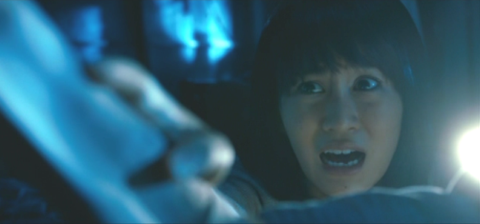
Asuka (Atsuko Maeda) is a nursing student who has moved into a new apartment with her parents and younger brother in preparation for her next tutoring session, but when her mother instructs her to go over and see their neighbours and introduce themselves with the gift of cakes, she is reluctant. This feeling of apprehension is confirmed when she rings the bell of the apartment across the hall and merely gets the door open a crack but no more, whereupon it slams shut; she pushes the cakes through the letterbox in their paper bag and ventures outside. There she finds a little boy playing by himself in the sandpit, so she greets him yet the sole response she gets is for him to run away. People sure aren't friendly around here, huh?
We have an inkling about what is going on when the girls at the nursing class point out the complex Asuka has taken up residence in has something of a reputation: it's haunted! She doesn't think she's seen much evidence of that, yet as if the discussion has placed an idea in her mind, as the story goes on she experiences more and more strange things until the great big twist arrives. In truth, you could probably guess what that was by picking up on the clues the screenplay littered about the opening scenes, but you could just as likely be genuinely surprised, though not as surprised as you might have been by certain other examples of this director's work, or, let's face it, one example in particular.
That director in question was Hideo Nakata, and the film that made his reputation internationally as well as at home in Japan was Ring, which itself spawned many imitations, remakes and sequels, some of them American. Seeing his name in the credits meant if you recognised it you were prepared for some supernatural shenanigans, and you would not be disappointed, though one thing you might not go through was outright shock, or even fear in a suspenseful frame of mind, since Nakata was in some sense a victim of his own success. From the first few minutes you were expecting something to be up, something ghostly, a curse or two, maybe even something ghastly, and it would be reasonable to observe you would not be disappointed.
That said, the whole J-Horror genre had been so flooded that unless you really hadn't watched any instances of it, or even knew the references from elsewhere, then there wouldn't be much to take you aback with Asuka's tale. When the little boy does strike up a conversation, it's all Nakata can do not to set off a klaxon that the tyke has some connection to the weirdness she has started to sense, such as being woken at half five in the morning by her antisocial neighbour's loud alarm clock. However, a mention of a tragic news story in class about an elderly couple found dead some time after they had expired because nobody thought to check on them arouses her suspicions and she tentatively tries the door to the older man's apartment, discovering an unpleasant sight.
Could it be the old man who is the ghost this time around? There's certainly a sequence halfway through that emulated the famed television scene of Ring, but in this case it's not the grand finale it's the lead up to the big revelation about what is actually happening to Asuka. The narrative presents as its main theme the dread of abandonment, something both the villainous and the heroic suffer alike, as being left alone in this world or the next appears to be the worst thing that can occur to you, yet not everyone has the abilities at their disposal to stave off that loneliness. The deep scratches the old man left in his wall could just as easily been his tries to make contact with Asuka, as her bedroom was on the other side, a neat visual metaphor in itself as well as a typically uneasy image Nakata tended to trade in. Bringing in heartthrob Hiroki Nariyama in the second half as Sasahara, our leading lady's apparent love interest who might just be her saviour too, raises the stakes, but also brings into question how sensible the characters are behaving. Not bad, but not great. Music by Kenji Kawai.