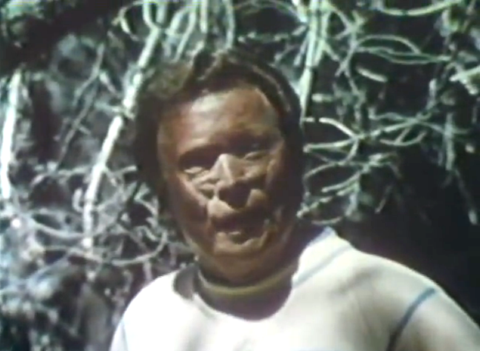
Before 1961, Merrill Womach had been gaining recognition for his music, as he was a gospel singer who accompanied himself on the organ, boasting a powerful voice to match the depth of his religious faith. He was married to Virginia, his childhood sweetheart, and had children with her, but that fateful year was when his life changed forever. He was a pilot too, and was flying through a terrible snowstorm in Oregon, just before Thanksgiving, when he found conditions were so bad that he was forced to make a landing not on the landing strip at the airport but in the forest surrounding it. The result was a personal disaster: the aircraft crashed, caught fire and Merrill was seriously injured with almost one hundred percent third degree burns...
But Merrill had a secret weapon to get him through tough times, or would have been a secret if he hadn't decided to proclaim it from the highest heights, whether you were interested or not. He Restoreth My Soul belonged to a specific set of religious documentaries, this example around a half hour long, to be shown at American Christian meetings designed to lift the spirits and generally make the congregation feel a lot better about the whole God business. To their credit, they can still have the same effect today, but there was a different group of cultists who were attracted to them, not because they wanted to be theologically fulifilled, but because these projects offered a grim fascination.
And a helping of unintentional laughter as well. Now, in the case of Womach we were talking about a man who had been through an unbelievably traumatic ordeal which basically saw his face and hands rebuilt from scratch, so it seems rather cruel to make him the butt of any humour, yet when you actually watched what director Mel White had in mind to bring the message of Christ through his subject to the masses in all its cheesy seventies glory, then you may begin to cringe. That someone turned the plane wreckage into a huge crucifix is bad enough, but more uncomfortably White included graphic photographs of Merrill's injuries, so you could imagine the more squeamish members of the assembled squirming in their seats when yet another hamburger-meat-face closeup was presented for our edification.
Merrill as he was in 1975 still needed more operations - so naturally what better way to end the film than with footage of that? - but you had to credit his surgeons for while he was still obviously an injured man, they had at least made him look human again, and his chipper personality was undimmed. This is where it begins to get bizarre for the more rational viewers, as he didn't take his accident as God's way of telling him to keep it quiet, or even that no sane God would allow one of his most faithful worshippers to suffer so, but quite the opposite: this was a sign from above that he was doing exactly the right thing. You could link this back to the Medieval interpretation of Christianity that we were put on Earth to suffer and the more turmoil you go through the better deal you'll get in Heaven (see Mel Gibson's supremely masochistic The Passion of the Christ).
You could also point out that if it had not been for his faith, Merrill wouldn't have pulled through his torment, so it wasn't all bad, but then there's the problem of what kind of God would allow it to happen in the first place looming. He moves in mysterious ways, as director White, father to actor and filmmaker Mike White, eventually conceded after a career of penning reactionary sermons for fundamentalist preachers, then came out as homosexual and tried to reconcile his beliefs with the intolerance his established religion showed for his orientation. Back when he made this, on the other hand, he was far less understanding and He Restoreth My Soul has no wish to get into the weightier questions, it was as shallow as your average Sunday School session, as seen when Womach visits a group of injured men in a hospital ward to give them a pep talk, then in incredible scenes mimes to one of his stentorian records as the unfortunates sit around miserably. It's bits like that which gave works like this their queasily camp reputation, in spite of its demonstration of the power of positive thinking.